


Vol. XXVI, No. 5, May 2026
Dave & Buster's, a legacy LBE canary in a coal mine
Dave & Buster's reported their 12th consecutive decline in comparable same-store sales for the fourth quarter of 2025.
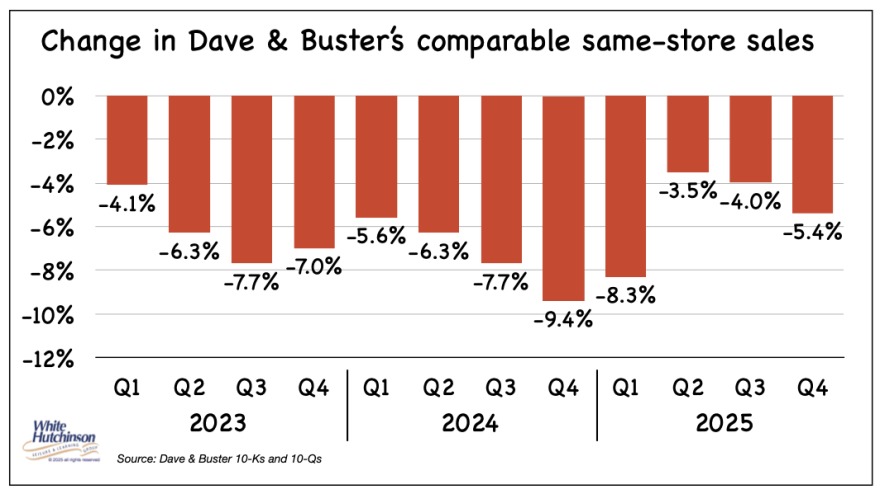
Compared with their pre-pandemic 2019 Q4, their comparable same-store sales fell 5.4%, which might not seem too bad. However, this doesn't account for inflation, since a dollar in Q4 2019 is worth much less than a dollar in Q4 2025. In fact, it's worth over 26% less. Therefore, D&B's comparable same-store sales have actually declined by nearly one quarter (-24.9%) when adjusted for inflation. That's a significant drop in comparable same-store sales.
After the 2022 acquisition of Main Event, Q4 comparable same-store sales for 2024 and later are labeled as ‘pro forma combined comparable store sales,' which include both Dave & Buster's and Main Event. Main Event FECs make up about a quarter of D&B's stores (179 D&B locations and 64 Main Event FECs, totaling 243 venues). If Main Event were performing better than Dave & Buster's units, it would imply that the comparable same-store sales for Dave & Buster's units are even lower. Unfortunately, D&B doesn't provide any data on the performance of each concept separately. As a result, we have no choice but to assume that both concepts have similar comparable same-store sales performance.
What explains the ongoing decline in comparable same-store sales at Dave & Buster's? We believe the traditional model of keeping attractions or game rooms separate from the restaurant dining area no longer aligns with the preferences of younger adults. Today's young adults seek venues that combine food, drinks, and gaming into a single social environment, rather than a completely separate dining space. Another flaw is that game rooms are not necessarily highly social, as many of the games are single-player.
D&B is losing customers amid a shifting competitive landscape that now includes many specialized eatertainment experiences, competitive socializing venues, and social game eatertainment venues (see last issue's description of the two). These venues target young adults aged 21-45, who make up 65% of D&B's customer base. These new venues pose a serious challenge to Dave & Buster's, especially for its large legacy locations that combine a restaurant with an extensive game room as the only participatory entertainment.
Dave & Buster's recognizes that its large-box legacy units, which combine a restaurant and a big game room, have fallen out of favor with younger adults. As a result, it is shifting strongly toward a competitive-socializing model with its “Store of the Future” format, featuring new elements that emphasize a unified social experience of playing, watching, eating, and drinking.
- The Arena is a new proprietary, room-scale, fully immersive group gaming attraction where the entire room becomes a video game for short, replayable mini-games.
- Interactive social suites with darts and shuffleboard for 2-6 players.
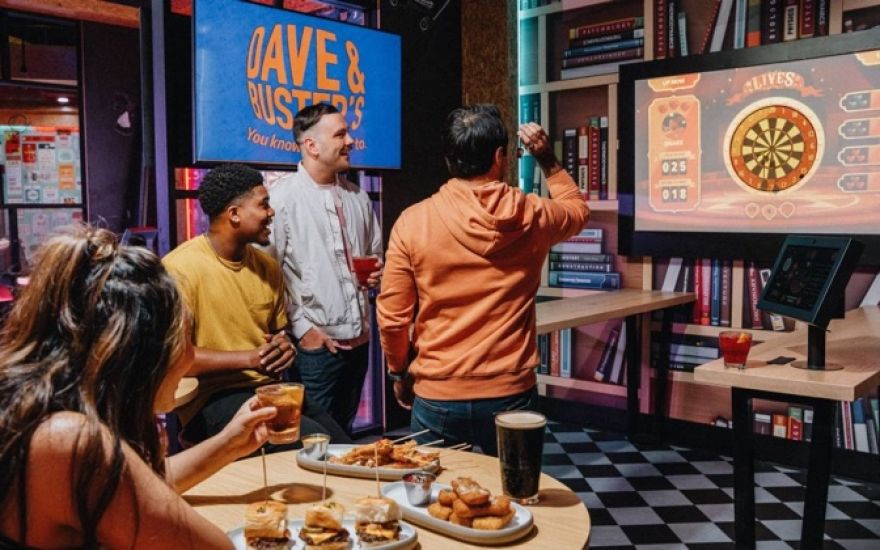
D&B Social Suite with darts
- An “Immersive Watch” sports experience featuring an expanded bar and sports-viewing areas, VIP watch rooms with bottle service, and a massive 40' WOW Wall screen.
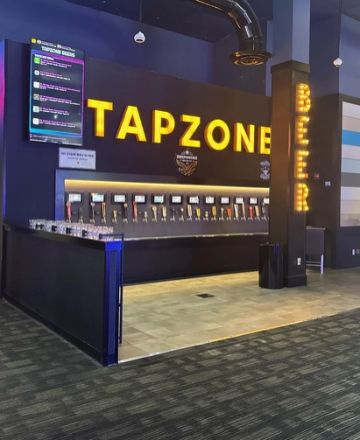
- TapZone self-serve beer wall: A self-pour beer station with over 20 taps, offering local craft selections and a more interactive bar experience inside or next to the midway.
- An updated menu focusing on shareable items rather than traditional entrees served in a restaurant setting.
As of the end of fiscal 2025, Dave & Buster's has remodeled 51 company-owned stores (28%) to the new Store of the Future format since the program began in the second half of 2023. Management reports that remodeled locations are achieving about 7 percentage points higher comparable same-store sales growth than non-remodeled legacy locations.
Even if all Dave & Buster's concept stores were remodeled, a modest increase in comparable same-store sales would not return D&B's store sales to late 2019 levels. Comparable same-store sales would need to increase by one-third (33%) to match inflation-adjusted store unit sales from five years ago.
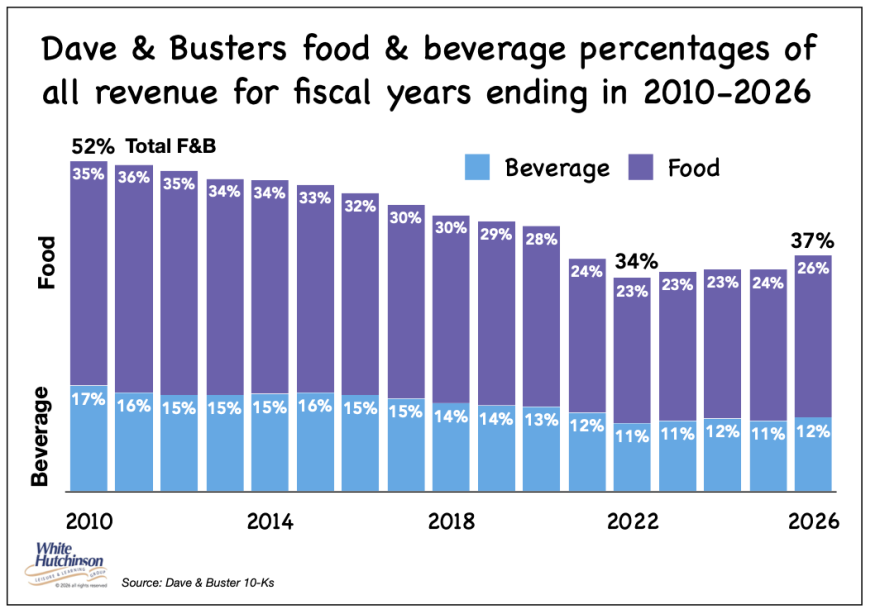
However, the remodels might be improving food and beverage sales. In 2010, most of D&B's revenue, 51.8%, came from food and beverages (35.2% and 16.6%, respectively). This proportion steadily declined through 2022 (fiscal year ending January 2023), falling by more than one-third to 33.5%, partly due to fewer customers dining there.
In early 2024, D&B's CEO, Chris Morris, said, "Over the last decade, the food and beverage mix has steadily declined. It's decelerated more than any other part of the business. There was a time when Dave & Buster's generated more food and beverage revenue than entertainment [54% in 2004]." He stated that D&B isn't seen as a dining spot. He added that consumers are dining out in large numbers, but they're doing so elsewhere, either before or after visiting Dave & Buster's.
Starting in 2023, the F&B revenue share of total revenue increased to 37.1% (25.5% from food and 11.6% from beverages). This may indicate that the Store of the Future remodels are having a positive impact. Alternatively, it could mean that adding Main Events to the mix improved the F&B revenue share.
Time will tell whether D&B's efforts to revitalize its Dave & Buster's locations will succeed. Many of the changes they're making in the remodeled stores make sense given what today's young adults look for at location-based eatertainment venues. D&B's biggest ongoing liability may be its large game rooms with 150-200+ games. Game rooms as destination attractions have lost their appeal and no longer fit the new social play, eat, and drink model. Even with the addition of the self-serve beer wall in or near the game room, most arcade games don't easily accommodate having a drink with you.
Subscribe to monthly Leisure eNewsletter