


Vol. XXVI, No. 5, May 2026
Getting LBE/FEC design right the 1st time to maximize profitability
Over the past 37 years, our company has discussed in our newsletters and blogs and presented at conventions and seminars the many factors that need to be considered in the architectural and interior design of location-based entertainment facilities (LBEs), including family entertainment centers (FECs). The design of the physical facility has a profound impact not only on the cost of the project but also, if not more so, on the quality of the guest experience, which directly affects revenues and the cost efficiency of operating the business. In other words, design directly affects:
- Development cost
- How much your guests enjoy the experience of visiting
- How long they stay
- How much they spend
- Whether and how often they return
- What it costs to operate the business
- Profitability and return on investment
Most design decisions are permanent, or at the very least, costly to correct. In most cases, the cost of developing a center with a flawed design is the same as developing one with a good design. So, getting the design right from the beginning is very important to long-term success and profitability.
Yet as critical good design is to success, many LBE/FEC developers continue to make multiple design errors that permanently handicap their profitability and, in some cases, threaten their very survival. In our travels, we have probably seen 1,000s of location-based entertainment centers of all types. We continue to see the same major design errors repeated. What causes so many owners of these centers to get it wrong?
In most cases, the problem is not intentional. In fact, the owners are following what they believe to be the correct approach, the conventional wisdom of hiring a local architect to design the center. Unfortunately, this choice is the root cause of the problem and stems from a myth created and perpetuated by the architecture profession. The myth is that any architect is qualified to design any type of facility. This is essentially equivalent to the idea that any doctor is qualified to treat any type of ailment or disease or to perform any type of surgery. Just as medicine has its specializations, so too is specialization required for designing different types of business facilities, such as LBEs and FECs. Other examples of specialized facilities that require design expertise include sports stadiums, hospitals, biotech labs, childcare centers, and airports. Before we have architects writing us about this observation, we want to acknowledge that there are architects who are the exception. Although in the minority, there are ethical architects who will not take on an assignment from a client for a specialized building type they do not have the required experience and expertise to design.
Unfortunately, most architects will accept any design assignment despite their lack of training, experience, and expertise in the specific business and facility type. For offices or warehouse space, the required expertise is minimal, as these are buildings, not businesses. But for specialized facilities, like LBEs, the design is much more than the design of a building; it is the design of a business.
What typically happens in the development process is that an entrepreneur LBE developer will find an architect in the local area and hire that individual to handle the architectural design. Rarely will the architect say, "Sorry, but I am not really qualified to do this for you. This is a very specialized type of facility, and I don't have the expertise to do a good job for you." Imagine going to your general practitioner or internist and asking that person to perform heart surgery on you. Yet most LBE developers essentially do the same thing when they hire local architects.
Architects, especially younger firms trying to get established and gain business, often use a marketing ploy that helps reel in the unsuspecting entrepreneur. They offer to do some initial design work for FREE. This is known in the industry as doing work on the come. Most entrepreneurs want to minimize their upfront expenditures until they secure required zoning and financing, so the idea of getting preliminary design work for free has great appeal. But because the work is unpaid, the architect may not invest the time and effort that would go into paid work. So, what the entrepreneur ends up with is a preliminary design for an LBE by an architect who doesn't know what good LBE design is and who has probably expended only minimal effort. It's back to the old maxim: you only get what you pay for.
What happens next is the fatal pitfall. The entrepreneur secures the required zoning and financing and proceeds with the project design, now essentially cast in stone. And, of course, the entrepreneur hires the same architect, feeling obligated for all the "great work" done for free (oh, if they only knew!).
It's not over yet, though. The architect is now in charge of the design, and because architects tend to have large egos when it comes to their designs, any suggestions for improving or correcting the design fall on deaf ears (the architect's). Furthermore, because the zoning approvals and financing were based on the original preliminary design, changing any basics in the design becomes very difficult, if not impossible.
Another sales pitch technique architects sometimes use to seduce LBE entrepreneurs into their fold is to tout how "creative" their designs are. They will show the entrepreneur great-looking photos of their projects and brag about the awards they have won for their creative designs. This all sounds great on the surface, but in our experience, "We are very creative" typically translates to: "We don't know anything about your project type, but we are sure we can find a creative design solution that is neither based on past experience, what has been proven to work in the industry, nor will generate the most business for you. But with the right photographer, we can win a design award with it." Whenever you hear an architect or other designer bragging about how creative he or she is, run for the hills, as creativity doesn't usually translate into business success and profits.
Some architects try to overcome their lack of expertise in LBE design by telling the developer they will engage an industry consultant to help, implying that the design will be based on industry expertise. This is the same technique many architectural firms use to win a request for qualifications (RFQ) or a request for proposal (RFP). They bring on an industry expert to add to their team, borrowing that person's reputation to gain credibility as experts in that project type. Unfortunately, this rarely, if ever, results in the best design.
Just having a consultant provide occasional input, which is about as often as an architect will seek it, doesn't result in a very complex set of design considerations coming together in a good design. As the architect works on the design, he or she isn't even aware of all the considerations unless the consultant is continuously looking over their shoulder, which never happens. The architect doesn't know what he/she doesn't know. Another problem with this approach is the ego of most architects. Too often, no matter what the consultant tells them, the architects still design the way they think is right, ensuring that the consultant's knowledge and expertise never get fully reflected in the design.
There's one more issue with most architects. Architects are trained to design buildings, and the primary factors that shape their design are building codes and structural and mechanical system considerations. Of course, these are important design considerations. But a LBE's guests' experiences are also, if not more so, affected by the emotional, aesthetic, and comfort qualities of the interior design and its furnishings. This is something that interior designers, not architects, specialize in. Most smaller architectural firms do not have interior designers, so the architect is in charge of the interior design and furniture selection. And for the larger firms that do have staff interior designers, all too often the architects still run the show. A local architect may design a code‑compliant box that feels more like a strip‑mall restaurant than an experience‑driven venue optimized for social energy, high per capita revenues, and repeat visits.
When it comes to a complex business such as an LBE or FEC, the devil is in the details, hundreds of them. Many factors require specialized knowledge that only comes from years of industry experience, and each one affects the others. There's the issue of adjacencies - what is placed where. There's theming. There's designing to minimize staffing during slow periods. There's queuing, traffic flow, and wayfinding. There's right sizing, entertainment capacity and throughput considerations. There are acoustics and lighting. There's atmospherics, which deals with the psychological and emotional feel of the center. It takes a specialist in the industry to know how to create a successful design.
What is the solution for entrepreneurs developing LBEs? The answer is not all that complicated. Hire one of the design firms that specializes in the design and development of LBEs of the type you are developing. No, none of these firms will do upfront work for free in hopes that the project will move forward and the firm will get the full design contract. As specialists, their services are in demand. They deliver value, and they will charge you for their work. The bottom line is that if you hire a specialist, you will get a project that will maximize profits rather than one that has built-in handicaps.
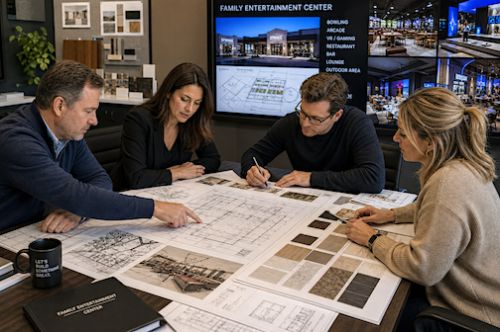
Our firm, the White Hutchinson Leisure & Learning Group, takes the approach of producing LBEs, and FECs for our clients rather than just designing them. All aspects of the business and the facility's design are fully interdependent, which is why we use a coordinated, integrated process to design the entire business rather than just the site and building. Our experienced production team is managed by the principal of our company, Randy White, who has over 37 years' experience and knowledge of all aspects of LBE feasibility, operation, management, marketing, and economics, as well as design. Our production team includes architects, who are very important team members, but the architects do not oversee the process. They are just one of many designers on the team. Our production team also includes interior designers who understand the emotional and psychological aspects of interior design, MEP engineers, civil engineers, kitchen designers, equipment specialists, landscape architects, and other specialized designers, depending on the project. Our architects, designers, and engineers are either licensed or qualified to obtain licenses in nearly every state.
When you develop an LBE/FEC, you only get to build it once. Getting the design right is critical to long-term success. There are no shortcuts or cheap routes to that success. You will only get what you pay for. Paying for the necessary specialized production and design expertise upfront is an investment that will yield the most successful and profitable project.
Subscribe to monthly Leisure eNewsletter