


Vol. XXVI, No. 7, July 2026
- Editor's corner
- The rise of agentic AI and its impact on location-based entertainment
- Dave & Buster's continues its decline
- The premiumization of location-based entertainment
- Soft socialization: a new playbook for adult social eatertainment
- How the immutable laws of marketing are reshaping the location-based entertainment industry
How the immutable laws of marketing are reshaping the location-based entertainment industry
Back in 1994, marketing gurus Al Ries and Jack Trout published what has become a classic book on marketing, The 22 Immutable Laws of Marketing, Violate Them at Your Own Risk! Their use of the term marketing refers to marketing in its broadest sense, product or service development - designing the consumer offering so it will be successful. Too many people mistakenly think marketing is solely focused on advertising. However, if you don't develop the right offering that appeals to the consumer, no amount of advertising or discounting will solve the problem.

Their book discusses basic universal principles or laws of marketing that have been proven over decades across all categories of consumer products and services. These laws are immutable, incapable of change, or unsusceptible to it. The book's 22 laws for marketing apply just as much today as they did in 1994 for succeeding in the marketplace, including for location-based entertainment.
What we see too often in the community location-based entertainment (LBE) industry, which includes family entertainment centers (FECs), is that developers and owners don't understand that these immutable marketing laws apply to their venues. They try to follow what they think works, even though what works is counterintuitive and has repeatedly been proven wrong in marketing. For some reason, the developers and owners think LBEs and FECs are a unique category with their own set of marketing laws. How wrong they are.
Here are a number of the Immutable Laws that continually reshape the location-based entertainment industry.
- The Law of Division
Over time, a category will split into two or more categories. As a result of this law, the marketing arena will always be an ever-expanding sea of categories. A category will start as a single category. Computers, for example, began as mainframes. Over time, the category broke into other segments - workstations, laptops, tablets, smartphones, etc. Beer started the same way. Now we have imported and domestic beer, premium and popular-priced beer, light, draft, pilsner, ale, lager, low-alcohol, non-alcoholic, etc. - Law of the Category
If you can't be first in a category, create a new one you can lead. It's hard to gain leadership in an established category. Everyone is interested in what's new. Few people care about what's better. - Law of Sacrifice
You must give up something to get something. A generalist is weak. A specialist can build a strong brand. This means sacrificing part of the larger market to gain a greater share of a smaller niche market.
Back in the 1980s and early 1990s, when indoor family entertainment centers (FECs) first emerged, the first centers opened with the idea that they would win by being first for everyone. They tried to cater to all age groups with offerings for children, teenagers, and adults. Yes, they were first, but the industry quickly evolved, and more specialized concepts focusing on narrow market niches emerged, such as children's entertainment centers (soft play centers) and adult-oriented facilities like Dave & Buster's (Law of Category). These concepts gave up part of the broader market to do a better job with a market niche (Law of Sacrifice). Centers that did a better job with just one attraction, such as laser tag, took ownership of those attraction categories. The original FECs "with a little bit of something for everyone" lost market share. Categories continued to evolve with different types of children's centers, such as pure entertainment, edutainment, play cafes for preschoolers, and centers offering various attractions such as inflatables and trampolines. Today, adult-oriented concepts continue to evolve, especially the new social eatertainment (competitive socializing) adult-oriented concepts with golf driving venues like Topgolf, darts, bowling, axe throwing, shuffleboard, or other social games, which own their categories (Law of Category) and take market share from other older concept centers.
Yet, we continue to see new centers being developed that replicate the industry's past by trying to appeal to everyone with a little bit of everything, and older concepts that are now out-of-date given the consumer's and industry's continuing evolution (see this month's article on Dave & Buster's).
For many older LBEs and FECs, it's time to rethink their business models as the out-of-home leisure and entertainment industry has evolved. New models are taking market share from older ones, as the LBE adoption model shows.
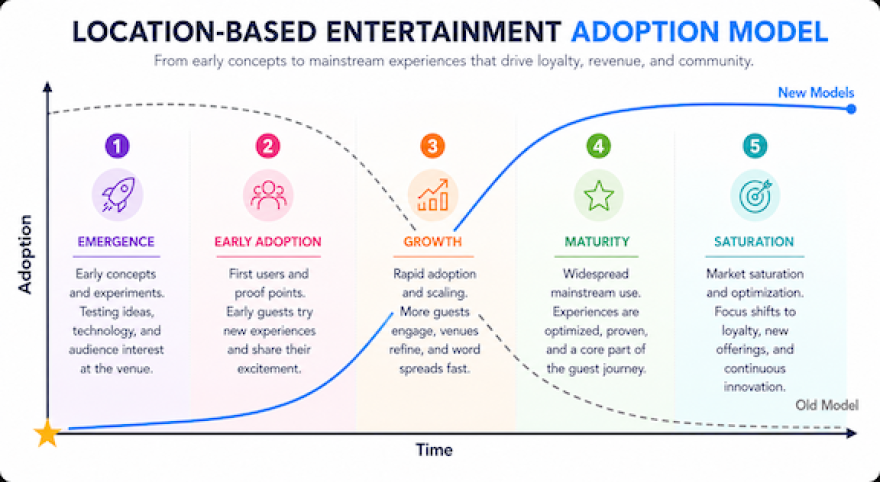
Today, the consumer has evolved. With them, the industry has evolved into so many niche concepts (The Law of Division) that the traditional FEC model is increasingly obsolete. Today, there are only two long-term viable categories, except for a small number of unique, focused concepts in major metro markets:
- Kid-focused venues - Playing games or participating in attractions designed for them, which can be done with their friends, classmates, or other kids.
- Adult-focused venues - Places for socializing, eating, and drinking while playing games or participating in attractions that facilitate socializing with friends, family, and coworkers. Although adult-focused, they can still work for families, especially during the day.
In addition to increased competition due to the Law of Division, the classic family entertainment center has also lost appeal as family time has taken on a new meaning. Family time today is entirely different from that of Gen X parents. Gen X parents often let their children rule, especially when it came to choices for family leisure time together. By contrast, today's parents don't want to relinquish control or give up their personal pursuits in favor of their children. There's now a new family dynamic of "we're in this thing together."
Most of today's parents say that it's no longer about kid-specific activities when they think about things to do with their children. They want new, interesting experiences that fulfill them personally while bringing their kids along for the ride. 40% of dads even say they have no problem bringing their kids to bars. That is why Dave & Buster's, a 100% adult-oriented venue that doesn't have Whac-A-Mole or other children's games, nevertheless reports that it attracts one-third of its attendance from families with children.
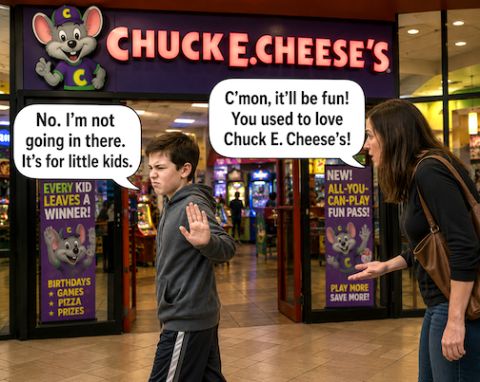
Another phenomenon fuels a shift of "family time" away from children's venues to places that satisfy parents' entertainment preferences - KGOY, kids getting older younger. Children's age compression, with children becoming more sophisticated for their age in what appeals to them, has shrunk the age range that children's entertainment centers appeal to. In the early days of Chuck E. Cheese's, it appealed to children up to around age 12. Today, it would be rare to find a 9-year-old wanting to go there.
Yes, the Immutable Laws of Division, Category, and Sacrifice are making the classic family entertainment center formula increasingly less relevant to customers seeking out-of-home entertainment.
If you build it, will they come?
Creating an enticing social venue for young adults takes more than just installing a couple of shuffleboards and electronic darts. To capitalize on this trend and entice young adults to step out of their safe, cozy cocoons at home, it is necessary to cultivate a compelling social environment. Here are some tips to create that environment:
- Make it adult - Although nothing about social gaming is inherently adult-oriented, such as at a club or a bar, young adults still look to socialize in an adult-focused environment. One way to do this is to provide a consistent evening transition for 21-plus guests. This both sharpens the brand and assures guests that while earlier dayparts may accommodate mixed-age groups, the night belongs to adults. That predictability appeals to couples, friend groups, and young professionals who want a social space that clearly feels “theirs” after a set hour.
- Make it delicious - Offer high-quality, foodie-worthy menu items that pair well with social gaming, handhelds, apps, burgers, etc. If you are curious about what this food-centric cohort is looking for, check out our article on 2026 food trends here.
- Make it alcohol-optional. Since alcohol is no longer the unquestioned center of the occasion, zero-proof and low-ABV drinks need to be treated as equally valid options. This means offering guests a variety of low- and no-alcohol beverages that match the sophistication and variety of your standard alcoholic menu.
- Make it predictable - Part of what makes soft socialization so appealing is that guests know what to expect from their evening. By offering bundled packages of game play and food and beverage, you allow guests to budget their time and money effectively. The guest walks in knowing what the evening will include, how long it will last, and what it will cost.
- Make it comfortable - Since social is in the name, design your facility around socialization. Provide your guests with furniture layouts and acoustics that allow them to relax and socialize at reasonable volumes, and create a warm, inviting environment with lower ceilings and soft furnishings. Avoid tall ceilings, hard surfaces, and poor acoustics that so often plague the LBE industry.
- Keep it fresh - Well-thought-out event programming can keep your venue feeling fresh and relevant to repeat guests. Theme nights, tournaments, trivia nights, and movie nights, especially those tailored to your demographic, will keep guests coming back again and again. Pair these with themed LTO food options, cocktails, and mocktails to make each experience feel unique. Think Cuban entrees with salsa lessons, an 80s night complete with nostalgic 80s cafeteria food (tater tots and rectangular pizza, anyone?), or a screening of The Godfather with Italian-themed drinks (alcoholic and non-alcoholic, of course) and appetizers. For more ideas, check out our recent article on repeat attendance
The bottom line
Today's young adults are reshaping nightlife, trading loud, alcohol-fueled nights out at the club for lower-pressure, structured fun that LBEs are uniquely positioned to deliver. Pair that with eclectic programming and high-quality food and beverage offerings in a well-designed, adult-centric social environment, and your LBE could become the next hot night spot.
Subscribe to monthly Leisure eNewsletter
Vol. XXVI, No. 7, July 2026
- Editor's corner
- The rise of agentic AI and its impact on location-based entertainment
- Dave & Buster's continues its decline
- The premiumization of location-based entertainment
- Soft socialization: a new playbook for adult social eatertainment
- How the immutable laws of marketing are reshaping the location-based entertainment industry