


Vol. XXVI, No. 7, July 2026
- Editor's corner
- The rise of agentic AI and its impact on location-based entertainment
- Dave & Buster's continues its decline
- The premiumization of location-based entertainment
- Soft socialization: a new playbook for adult social eatertainment
- How the immutable laws of marketing are reshaping the location-based entertainment industry
The rise of agentic AI and its impact on location-based entertainment
Agentic AI might soon be the primary “friend” people turn to when planning a night out. That has significant consequences for location-based entertainment venues (LBEs).
The key question for any LBE operator is whether an AI assistant, when searching your region, clearly understands who you are, what you offer, when you're open, and how to book or buy tickets.
From searching to “just handle it for me”
Until now, most guests have typed queries like “arcade near me” into Google, skimmed a few links, and made their own choice. More people are now using AI tools to plan trips and nights out, not just to search for ideas but to build full plans. Many also use them to book things. Roughly one in three U.S. travelers already use AI tools for trip and experience planning, and recent travel-industry research suggests that overall, AI-assisted planning may now be approaching a majority of people. For example, a person might say, “Plan and book this Friday night for four coworkers, under $60 per person, with cocktails and casual games near my hotel,” and let the AI do the rest.
The key question for any LBE operator is whether, when that AI assistant looks around your city, it clearly understands who you are, what you offer, and how to book you.
How AI “sees” your LBE
AI does not see your business the way a person scrolling through Instagram does. It looks for clean, trustworthy facts:
- Who are you, exactly? Name, address, phone, website, and categories must match across all listings: your site, Google Business Profile, Apple Maps, Yelp, Facebook, and other listings.
- What do you actually offer? AI looks for readable text on your website, not just images and PDFs. It wants to see games, hours, age rules, menu basics, prices or price ranges, capacity, and the types of groups you're good for (date nights, kids' birthdays, corporate events, etc.).
- Are you any good, and for whom? It reads review text, not just star ratings. Phrases like “great for team‑building,” “loud bar vibe,” or “perfect for adult birthdays” help the AI match you to the right request.
Think of it this way: if a stranger had to describe your venue based solely on what's online, with no photos and no prior knowledge, would they have enough detail to recommend you with confidence? That's essentially what the AI is doing.
Why booking tools suddenly matter more
A second big shift: AI assistants are being connected directly to booking systems. In hotels, they're integrating with modern reservation platforms to check real-time availability and confirm stays without a human ever visiting the property's website.
The same idea applies to entertainment. Venues that display real-time availability for lanes, bays, party rooms, and ticketed events via well-known reservation platforms or clean online tools will be much easier for AI to work with. If the assistant can see “two lanes available at 8 pm” and book them in a couple of clicks, you stand a much better chance of being picked. If instead your message is “call for details” and “email us for pricing,” the AI often can't complete the booking. It may choose a competitor that is easier to book, even if your concept is better.
What LBE operators need to do now
Experts in hospitality and local marketing increasingly agree on a simple playbook
- Clean up your basics. Ensure your name, address, categories, hours, and phone number are consistent across your site, Google Business Profile, maps, and major review sites.
- Tell your story in plain, detailed language. Create clear pages for “Games & Pricing,” “Food & Drink,” “Groups & Events,” and “FAQ” that reflect how real guests talk and ask questions. Include typical spend per person, group sizes, and any age rules.
- Encourage specific reviews. Ask happy guests and event planners to mention what they did (“team‑building event,” “adult birthday,” “date night”) rather than just saying “we had fun.” Those details help AI match you with future guests.
- Make online booking simple. Use a well‑known reservations tool or a very clear booking flow so it's obvious how to reserve lanes, bays, or party rooms. The easier it is for humans, the easier it is for an AI assistant.
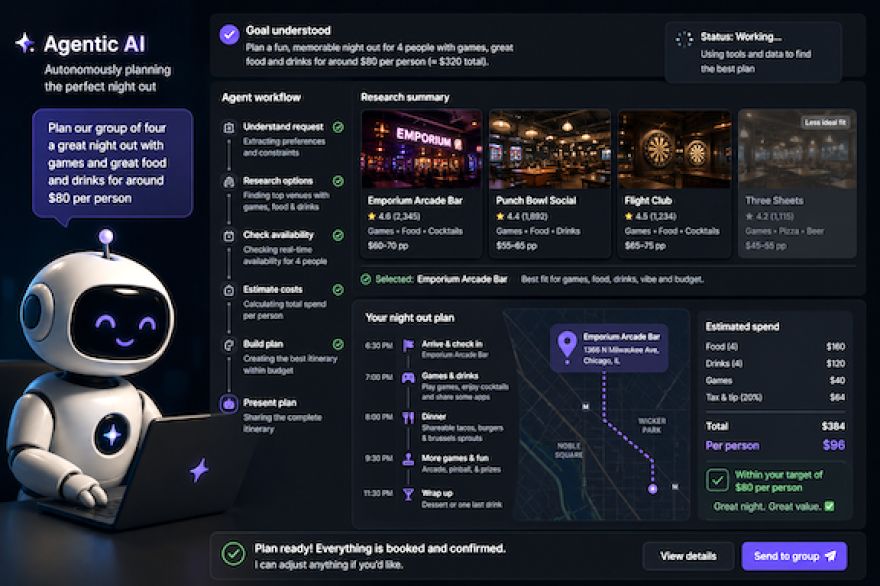
In an increasingly AI-driven world, it's not enough to be fun in real life. You also have to make it easy for technology to understand what you offer and for guests to book. Operators who do that well will appear more often when guests tell their AI, “Plan our group of four a great night out with games and great food and drinks for around $80 per person.”
Subscribe to monthly Leisure eNewsletter
Vol. XXVI, No. 7, July 2026
- Editor's corner
- The rise of agentic AI and its impact on location-based entertainment
- Dave & Buster's continues its decline
- The premiumization of location-based entertainment
- Soft socialization: a new playbook for adult social eatertainment
- How the immutable laws of marketing are reshaping the location-based entertainment industry