


Vol. XXVI, No. 11, November 2026
- Editor's corner
- How LBEs and FECs can increase their repeat appeal
- Food, drink, and play: Menu trends LBEs should consider in 2027
- Our latest social eatertainment project
- Less time together, more reasons to reconnect: the opportunity for social eatertainment
- Chuck E. Cheese's Adventure World brings indoor soft play full circle
- Drinking alcohol is down among regular drinkers
- Making the barbell work: Affordable visits and worthwhile splurges
Less time together, more reasons to reconnect: the opportunity for social eatertainment
Americans are spending less time socializing face-to-face, yet many young adults want more opportunities to connect IRL (in real life). For location-based entertainment venues, these trends present an opportunity: to create experiences that make it easy and worthwhile for people to get together.
Declining socialization does not necessarily mean people have lost their desire to connect. Research suggests that people still want to act on that desire. Social eatertainment can meet that need by combining food, drink, social games, and conversation.
The decline is substantial. Sociologist Neal Caren's 2026 analysis of American Time Use Survey data found that adults' weekly time spent with friends fell from about 350 minutes in the early 2000s to 170 minutes in recent years. Friday evening increasingly resembles an ordinary weeknight.
Data for Progress highlights familiar activities behind the trend. Comparing adult participation in 1995 and 2026, it found that the share who entertained people at home at least once in the previous year fell from 88% to 67%. The share attending a club meeting declined from 45% to 26%. Because the two surveys used different methods, these comparisons suggest trends rather than precise changes.
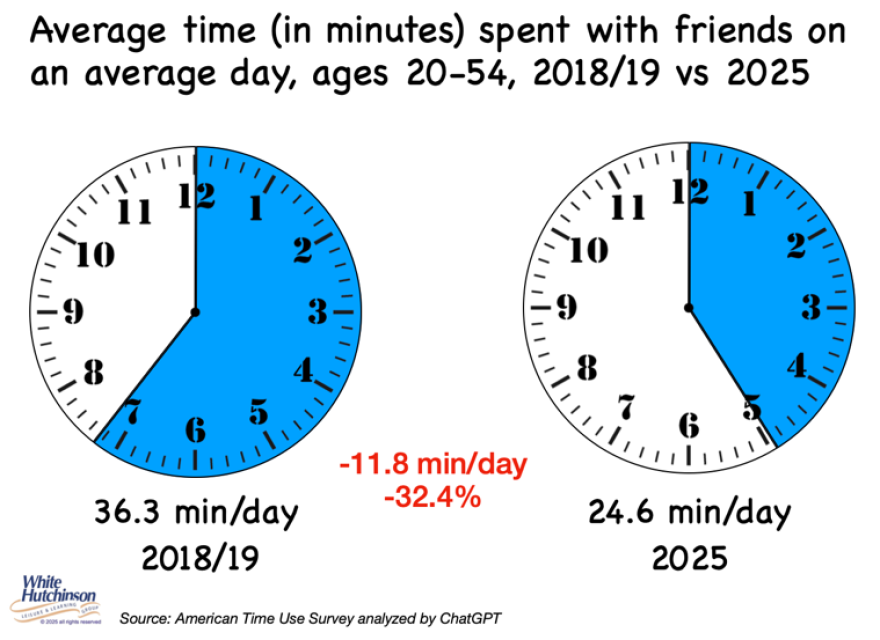
Data from the American Time Use Survey shows that people ages 20-54 spent about one-third less time socializing with friends in 2025 than they had before the pandemic.
Meanwhile, younger adults want to reconnect. Eventbrite's 2026 Social Study surveyed 4,051 people ages 18 to 35 in the United States and the United Kingdom and found that 79% planned to attend more events in 2026.
One finding is particularly relevant to social eatertainment. 58% preferred experiences where socializing was not the main focus. Eventbrite calls this “soft socializing;” an activity that provides a reason to attend and something to do together, allowing interaction to develop with less pressure. These are just reported preferences and intentions, but they do offer useful insight into the experiences young adults seek.
There is also evidence from reported outcomes. In Eventbrite's earlier 2024 survey of 2,000 U.S. adults ages 18 to 35, 84% of attendees at interest-based events reported forming close friendships at those gatherings.
These findings suggest one reason for social eatertainment's appeal. An invitation to meet for food, drinks, and a game gives friends a concrete plan and something to share upon arrival.
The simultaneous combination is central to the opportunity. Food, drink, and social games can support conversation throughout the visit. With bowling, darts, and golf-tainment, one person takes a turn while others watch, react, talk, and enjoy refreshments. Pauses between turns become part of the social experience. A good shot or friendly rivalry gives everyone something to share in.
For LBE developers and operators, this means designing for the group. Prioritize comfortable seating, tables within reach, convenient food and beverage service, and sound levels that support conversation. Games should be approachable enough for guests with different levels of experience to participate together comfortably. The person watching should still feel included.
Food and drink also need to justify the visit. A menu friends look forward to sharing, appealing beverages with and without alcohol, and attentive hospitality give the gathering substance beyond the game. Guests should be able to settle in and enjoy each other's company.
The opportunity is to make face-to-face connections easier to arrange and more rewarding to repeat. Social eatertainment provides the setting, shared activity, and hospitality. Its lasting value comes from what guests do with that combination: spending enjoyable time with their friends.
Subscribe to monthly Leisure eNewsletter
Vol. XXVI, No. 11, November 2026
- Editor's corner
- How LBEs and FECs can increase their repeat appeal
- Food, drink, and play: Menu trends LBEs should consider in 2027
- Our latest social eatertainment project
- Less time together, more reasons to reconnect: the opportunity for social eatertainment
- Chuck E. Cheese's Adventure World brings indoor soft play full circle
- Drinking alcohol is down among regular drinkers
- Making the barbell work: Affordable visits and worthwhile splurges