


Vol. XXVI, No. 4, April 2026
- Editor's corner
- The IRL singles-events trend offers an opportunity for LBEs
- Popular beverage options at favorite restaurants
- Why are birthday parties declining?
- Using AI to generate LBE projections for roadkill
- Avoid dividing your guests by age or generation
- How the 'competitive socializing' LBE label is creating industry confusion
How the 'competitive socializing' LBE label is creating industry confusion
While "competitive socializing" as a general concept has roots in traditional British pub culture (like darts and pool), its modern industry usage is credited to several key figures and venues.
- Entrepreneur Adam Breeden is widely recognized as a pioneer in the modern 'competitive socializing' industry through his UK concepts that combine games with upscale food and drinks, such as All Star Lanes (2006). This is often credited as the first modern example to introduce 'competitive socializing' by reimagining tenpin bowling with premium cocktails and dining. Flight Club (2015), founded by Steve Moore and Paul Barham, further solidified the term by applying it to "social darts," using technology to gamify a traditional pub sport.
- Kevin Williams is often recognized for popularizing the term in his weekly newsletter, The Stinger Report. He describes it as the "blending of a hospitality atmosphere married to a re-imagining of conventional competitive entertainment."
The trend has since expanded to include activities like ping pong (Bounce), shuffleboard (Electric Shuffle), and even cricket (Sixes), all of which incorporate games into upscale hospitality environments.
Unfortunately, the term 'competitive socializing' can be very misleading when used to describe a different category, which is better called 'social game eatertainment.'
Competitive socializing:
- Highlights competition as a central aspect, which is not very social.
- The focus is on the activity with quality food and drinks nearby, not enjoyed simultaneously while playing.
Social game eatertainment
- It involves a high level of social interaction.
- It includes casual games with low skill variance and a turn-taking rhythm, emphasizing social interaction over winning. The psychological focus is on shared play and conversation, not "who wins."
- Second, eating and drinking at the same time during gameplay enhances the social experience.
So, we basically have two types of these adult-focused venues:
- Social game eatertainment, like Flight Club, Topgolf, and various boutique bowling venues, especially those featuring duckpin bowling.
- Competitive social activities such as Spin, Bounce, Royal Palms Shuffleboard Club, Chicken N Pickle, and Puttshack.
What makes this somewhat confusing is that the same game can be found in both types of venues. For example, regular darts have greater skill-level variance because they require significant practice to master, especially given their small targets. In a venue where only drinks are available to enjoy alongside the game, not food, that would be considered competitive socializing. Conversely, electronic darts with larger targets and a lower skill-level variance, such as Krazy Dartz, played in a setting where both food and drinks can be enjoyed at the same time, exemplifies social game entertainment.
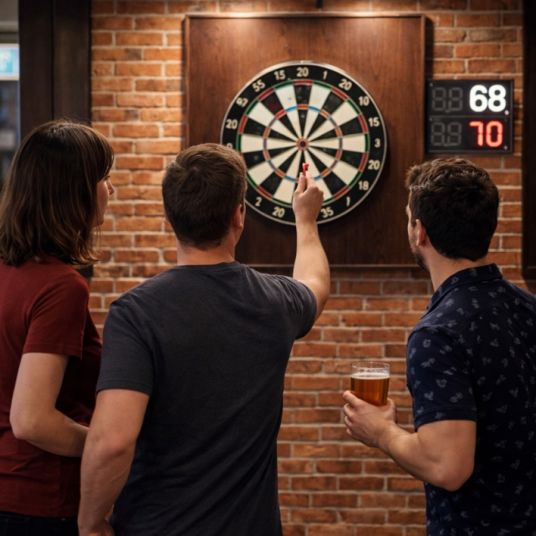 Traditional darts are competitive socializing |
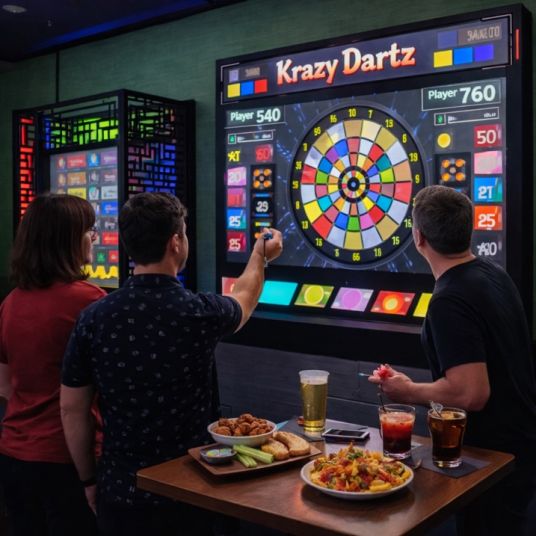 Krazy Dartz with F&B is social game eatertainment |
Although they originate from the same source and are related, it is incorrect to categorize social game eatertainment as competitive socializing, since they are clearly different.
Subscribe to monthly Leisure eNewsletter
Vol. XXVI, No. 4, April 2026
- Editor's corner
- The IRL singles-events trend offers an opportunity for LBEs
- Popular beverage options at favorite restaurants
- Why are birthday parties declining?
- Using AI to generate LBE projections for roadkill
- Avoid dividing your guests by age or generation
- How the 'competitive socializing' LBE label is creating industry confusion