

The following whitepaper was published in the June 2006 issue of RePlay magazine.
This article is also available for viewing and printing in Adobe Portable Document Format (PDF), which requires Adobe Acrobat Reader, version 3.0 or higher, or any other PDF-compatible reader. The Adobe Acrobat Reader is freely available from Adobe Systems, Inc.
Download a PDF copy of this article by clicking here.

Time is more than money It's the minutes, not the moolah: Making your LBE worth their time
by Randy White, CEO
© 2006 White Hutchinson Leisure & Learning Group, Inc.
We each get the same 24 hours each day, but how we spend them is increasingly different. It may come as a shock, but recent studies show that Americans have more leisure time than they used to. How much more, though, varies more than it used to depending on your educational level, income and gender. In fact, if you're female with children, you probably want to give some researchers a swift kick in the tuchus.
New studies underscore an important point for location-based entertainment (LBE) owners to consider: It's the minutes, not the moolah, that matters most. Many consumers are more worried about making a bad decision and wasting their valuable time than they are about wasting money. Knowing the ways in which different people view time and how much they have to spend can help LBE owners earn valuable customer minutes.
The research tells the story about shifts in leisure time in the U.S.
Americans have more leisure time today than in the past.
You knew all those labor-saving devices had to have some impact, right? A study by the Federal Reserve Bank of Boston has found that Americans have more leisure time today than we did in 1965. Researchers examined five time-use studies done at intervals between 1965 and 2003 and found that the amount of leisure time for non-retired men increased 19 percent and for non-retired women, 10 percent. The net gain for men and women combined was 5.1 hours a week or 270 additional leisure hours per year.

It's important to note that the definition of leisure changed when the Bureau of Labor Statistics took over data collection in 2003 because the BLS counted time spent with children differently. While 1965-1993 used the same measures, 2003 did not, which may account for the drop in women's leisure time between 1993 and 2003.
The researchers believe the increase in leisure is not because we are putting in fewer hours on the job - in fact, office hours are increasing - but because the time we spend doing household chores like cooking, housework, shopping and such has dropped. We eagerly await a follow-up study on America's growing population of dust bunnies.
People with more education have less leisure time.
The Bureau of Labor Statistics' American Time Use Survey (ATUS) found that the most highly educated Americans spend much less time on leisure and sports than the less-educated. In fact, someone with a bachelor's degree spends 29% less time on leisure and sports than a high school graduate and 42% less than someone without a high school diploma.

In 1965, people of all educational levels had about the same amount of leisure time, according to the Federal Reserve study, which agreed with the ATUS findings on leisure time differences today. A March 2006 study of vacation time by the Leisure Trends Group concurred, finding differences in vacation time based on pay level. It found that managers and professionals take just 54 percent of their allotted vacation time, while people who make less than $40,000 a year take 77 percent.
Got kids? Wave bye-bye to leisure time.
According to the Federal Reserve study, both men and women with children had more leisure time in 2003 than they did in 1965. Men had an additional 6.8 hours and women an additional 4.9 hours of leisure time per week. That's the good news. The bad news won't come as a surprise to any parent: Adults in households with children have less leisure time than adults in child-free households, according to the Bureau of Labor Statistics. Households with children spend 28 percent less time on leisure and sports during the week, and 18 percent less on weekends and holidays.
The biggest winners in the leisure-time sweepstakes were men without children, who in 2003 enjoyed 9.2 more hours of leisure time a week than did their counterparts in 1965. Women without children, on the other hand, have about the same amount of leisure time today as their 1965 counterparts.

Women, especially mothers, feel rushed even during leisure time
Two sociologists examined time diary data from two national surveys conducted in 1975-76 and 1998-99 and found that male and female parents experience leisure time very differently.
The sociologists, from Ohio State University and the University of Maryland, found that for women, especially mothers, free time isn't exactly free. Respondents were asked how often they felt rushed during a typical day. A summary from Ohio State notes that "men who were married and had children didn't feel more rushed in their daily lives than single, childless men. But the odds of feeling sometimes or always rushed were 2.2 times higher for married women with children than it was for single, childless women."
Each hour of free time in 1998 reduced men's odds of feeling rushed by 8 percent, but had no similar affect for women. Women were more likely to feel sometimes or always rushed in 1998 than in 1975, while men did not feel significantly more rushed in the later survey.
Women with children may also be more isolated, leading to increased stress. In its latest survey, the Leisure Trends Group found that women in the prime mothering years of 25-44 reported the highest level of stress in the history of their LeisureTRAK Report. Women in this age group reported spending the least amount of time socializing of all women. Only 16 percent of 25- to 34-year-olds and 13 percent of women 35-44 said they socialized during the previous day.
The more money you have the more you complain about lack of time.
Feel too busy? Maybe that's because you have too much money. While the more-educated do have less leisure time, according to two of our studies, one economist says that the feeling of being stressed goes up with disposable income.
The economist, Dr. Daniel Hamermesh from the University of Texas at Austin, studied couples in the U.S. and four other countries. He found that the more money people have, the more pressured they'll feel as they try to find ways to spend it all. This was true even if there was no change in the number of work hours. Conversely, Hamermesh found that people who have less money don't complain about a lack of time because they are more concerned about, you know, paying the bills.
Watching television sucks up about half of our leisure & sports time.
The Bureau of Labor Statistics study broke down how people spent the time that they allocated to meals and to leisure and sports. For the entire population of Americans 15 years and older, watching television consumed at least half of our leisure time. Between 2003 and 2004, Americans spent 3% more time in front of the tube.
Average hours per day
| Weekdays | Weekends & Holidays |
Total All Days | |
|---|---|---|---|
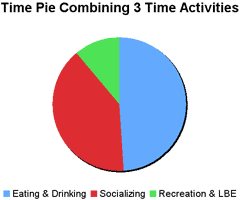
| Eating & drinking | 1.19 | 1.38 | 1.24 |
| Leisure & sports | 4.71 | 6.28 | 5.18 |
| Socializing & communicating | 0.59 | 1.13 | 0.75 |
| Watching television | 2.48 | 3.02 | 2.64 |
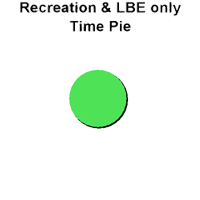
| Participating in sports, exercise & recreation | 0.27 | 0.35 | 0.30 |
Whether we like it or not, TV finds its way into our weekends, according to a 2005 study commissioned by LIFE magazine. The survey asked people to list their ideal and actual weekend activities. While few people listed watching TV as an ideal weekend activity, TV watching tied for second place with exercising on the list of things people actually did on their weekends.
While we're comparing "ideals," though, one group of survey respondents were just fine with hours spent in front of the tube. According to a study by the advertising firm JWT, American men, on average, considered 130 minutes the ideal amount of time to watch TV in the evening, with another 30 minutes in the morning. American women watched even more. They said 151 and 59 minutes were the right amount for TV watching in the evening and morning, respectively.
So what does this mean for LBEs?
In his widely read book, Bowling Alone, Harvard's Robert Putnam detailed changes in how our society operates. In the last 25 years, he found, there was a 58 percent decline in attending club meetings, a 33 percent decline in family dinners, and a 45 percent decline in having friends over. But he didn't call the book Dining Alone, now did he? No, he didn't, because among the trends he found was that people today are unwilling to make a months-long commitment to a bowling league and so now bowl alone. Instead of building relationships and a sense of community, they're on their own.
Changes in how our society functions have a massive impact on LBEs. The key is to adapt to societal changes and do it quickly. It's not just about keeping your business open, although that's important, it's also about filling a need and making people's lives better. The trends in leisure time suggest important changes that LBEs should make to adjust to shifts in American culture.
Create the kind of experience that feels like a treat
We got ourselves a little dichotomy here. People with more money have less time and people with more time have less money. So which do you try to attract?
Let's look at the numbers. People with upscale incomes - $81,000 or more, the top 20 percent of households by income - account for just over half of all fees and admissions at location-based entertainment facilities. The top 40 percent, with incomes of $52,000 or more, are responsible for 74 percent of all entertainment fees and admissions.
It's easy to see, then, why LBEs that focus on lower income consumers fail to pull in the funds they need to stay afloat. In an attempt to keep costs low, they build carnival-in-a-warehouse indoor LBEs and concrete-desert outdoor LBEs that repel upscale consumers and probably don't thrill the folks who worry about cost. Sales at these LBEs end up being marginal at best. Most fail to survive for any length of time.
Increased wealth in the population as a whole and the desire to make the most of our time has led to both the experience economy and the quest for affordable luxuries, known as "trading up" or "new luxury."
In the experience economy, people are no longer satisfied with mere goods and services. They want every activity to have the highest perceived value in the use of their time. They want more than a transaction, they want an emotionally rewarding experience, like what's available at Bass Pro, Cabela's, Restoration Hardware, Whole Foods or Williams Sonoma.
New luxury means that people are willing to spend a little more on those experiences that we view as affordable luxuries. Spending $3 on a cup of coffee at Starbucks or a little more for lunch at Panera Bread seems justified when it's a treat for all the soul-sucking, mind-numbing, physically and emotionally exhausting things we do in the course of the average day. We'll even scrimp on the necessities to pay for the small luxuries that make us feel good.
What does it take to ride this trend? We're not talking diamond-studded bumper cars, just nice finishes, thoughtful design, decent acoustics and employees who treat you like a human being. You'll make it worth the time of upscale consumers and worth the money of middle-income folks who are up for the occasional splurge.
Adapt to busy schedules
In the olden days, we had unstructured time in fairly large chunks. The weekend? Sure, we had to mow the lawn and pick up groceries, but most of it was ours to do with as we pleased. If we needed to wait 30 minutes to get a lane at the bowling center, no big deal. While people have more leisure time these days, it comes in smaller chunks. A family may have 90 minutes between the end of gymnastics practices and the start of the Little League game. They want to do something fun together and they can't count on luck to make it possible.
One option is to take reservations. Jim Kessler owns Lasertron Interactive Entertainment Center, the oldest continuously operating and most successful laser tag facility in the Buffalo, New York, metro area. His center now takes advance reservations for laser tag, even for the middle of a Saturday afternoon, and it has helped his business. In fact, this past winter the center set a record for reserved 30-minute laser tag sessions one Saturday - 1,160 sessions - probably the most minutes of laser tag ever sold by a laser tag facility in 14 hours.
Jim told us he made the change when he realized many families had only limited blocks of time between activities, and wouldn't come to Lasertron unless they were guaranteed they'd be able to play. Their available leisure time was too valuable to take a chance on a wasted trip. The reservation system at Lasertron has been so successful, that Jim is also taking advance reservations at his new Racing Experience go-kart track.
Jim isn't the only business owner who has adapted. You can now buy premium tickets to some theme parks that allow you to bypass the masses and go to the front of the line. And helping people multi-task is also becoming profitable. Most coffeeshops and even McDonald's have added wireless Internet so that diners can catch up on email or polish their proposals over lunch.
Meet multiple needs, not just the need for recreation
People need to eat, socialize and take part in recreation. Some LBEs meet only one need. Their food is barely digestible. And socializing? The noise level is such that even yelling won't get you heard. These LBEs are competing for a slice of a tiny little pie. Other LBEs, those with good food, pleasant surroundings and humane acoustics, have a much bigger pie at their disposal. Really, check out our graphic and see what we mean, using data from the Bureau of Labor Statistics:
Give stressed-out mothers opportunities to relax and socialize
If you're within earshot of someone who needs you to adjudicate an argument or make sure you don't stick your fingers in a light socket, does it really count as leisure? Not according to women with children. These moms need someplace where, for a brief joyous slice of time, they can relax and socialize while someone else makes sure the children aren't in peril.
If you can do this while at the same time providing fun and educational activities for the kids, so much the better. Edutainment also responds to a societal shift. While Boomer parents tended to separate their children's playtime and learning time, younger women in Generations X & Y want their children to learn as they play.
Our company has been designing and producing children's edutainment centers since they first began. One constant challenge is the client's desire for a model that doesn't require the large size and investment of most centers. It's difficult, though, to shrink edutainment centers because they need to be large enough to meet the demand during the busiest weekend times and to include a wide enough variety of play so that the children don't get bored.
We've met this challenge by developing a new type of edutainment center that is much smaller, which we call an at-home moms' café, often also referred to as a play cafe. We've reduced the size by keeping the center closed to the general public on weekends, when it's only used for scheduled birthday parties. During the week, the center targets at-home moms with their preschool children. They have access to great food, pleasant seating and high-quality play areas for their children, all within 8-10,000 square feet. It's an excellent model for upper-middle and higher income white-collar communities, usually well-developed suburban areas of a larger city.
Another example of how the LBE industry is evolving to meet modern consumers' time needs is the family pizza buffet-entertainment center (FPBEC), a nascent new category with over 40 centers now up and running that range in size from 30,000 to 90,000 square feet. FPBEC meet the combined needs of a quick casual family meal (no whining fidgety children while you wait to be seated or for the meal to be served) at a reasonable price, where everyone, including the children, get to pick out their own foods. There's entertainment and an opportunity for the family to socialize together.
StoneFire Pizza Co. a FPBEC we produced for our client in Milwaukee, is just one example. With 460 seats in five differently themed dining areas, a buffet with a wide selection of salads, soups, pasta, pizza, Asian foods, desserts and drinks, including a specialty coffee bar, party rooms and over 15,000 square feet of entertainment, it offers a modern one-stop multi-tasking solution for time-pressed families.
Each one of your customers gets the same 24 hours in a day. They can choose to spend some of those precious minutes at your LBE. Whether they do so depends to a large extent on whether you have made the effort to adapt to their schedules, their needs and their wishes. Are you willing to make the effort? The decision is up to you. But remember, the clock is ticking.
Randy White is the CEO of the White Hutchinson Leisure & Learning Group with offices in Kansas City, MO, U.S.A. and Doha, Qatar. The company specializes in the design and production of family and children's leisure venues, including entertainment, edutainment and mixed use projects. Randy can be reached at via e-mail or via the company's website www.whitehutchinson.com.