

Finding the Investment Sweet Spot
By Randy White
© 2001 White Hutchinson Leisure & Learning Group
The complicated relationship between investment and return for a location-based leisure facility (LBL) has been reduced to a simplistic formula that costs LBL owners profit and, sometimes, their businesses. It's as if you decided that you were going to open a car dealership, and the only car you were going to sell was the $19,000 Toyota Camry. Why? It costs about the average. So you open your dealership in a ritzy suburb and, whaddaya know, the Mercedes dealership down the street eats your lunch. Oh, dear, let's try again. So you open in a blue-collar community, and watch while Hyundais and Ford Escorts drive by. If only what you were selling matched what your customers wanted. Instead, you put your faith in the law of averages, and you got busted.
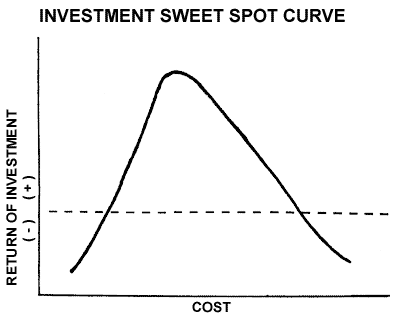
There is a better way. There's a place called the "investment sweet spot," where you've spent not too much, and not too little, but just the right amount to reach the maximum return-on-investment. And the secret is, the only way to hit that sweet spot is to focus on pleasing your guests.
The conventional method = wishful thinking
The sweet spot flies in the face of conventional wisdom, which says that the lower the development cost of a LBL, the greater the return on investment. Real life is more complicated. Just as over-investment in a LBL decreases return-on-investment, so does under-investment. In fact, there is greater risk of failure with under- than over-investment. There is a direct relationship between cost and return before the sweet spot is found-the greater the cost, the greater the return. Once the sweet spot is reached, the relationship becomes inverse-increasing cost means decreasing return (see graph below).
The traditional way to figure out how much to spend on a LBL takes none of life's complexity into account - it's just wishful thinking. The feasibility and planning process is to first forecast LBL demand or attendance, then project per capita expenditures and revenues and deduct projected expenses, with the result being cash flow or profit. The supportable investment is determined by capitalizing the net cash flow or profit by the desired return. For example, if the projected cash flow is $200,000 and the desired cash-on-cash return is 20%, the supportable investment would be $1.0 million ($200,000 ÷ 20%). Size calculations determine peak 'in facility' attendance on the 'design day', and the facility is designed to meet both the investment and design day parameters.
Notice something missing? The calculations don't include a key factor in a LBL's success, the guest experience, which determines guest attendance, spending and loyalty. All these calculations mean nothing without it.
The guest experience points the way to the sweet spot
The guest experience is the outcome of the guest's interactions with every facet of the facility and its operations. Guest leisure experiences are shaped by emotional and psychological reactions to the facility and operations. Some of the factors that shape the guest experience include:
- The sensory experience or atmosphere, which includes lighting, sounds, smells, flavors, physical sensations, comfort, aesthetic features, and the psychological ambience.
- Interpersonal interaction with staff and other guests.
- Procedures that guests must follow, and their ability to get information they need to function as guests.
- Goods, whether they purchase, consume or take temporary custody of them.
- The values of the guests and how they match the values reflected by the facility, including its marketing and operations.
- The financial and time commitment the guest must make.
- Entertainment and fun - more than the sum of the above. It also includes the guests themselves, who are the active participants in "making" their fun.
The result of the guest experience is a feeling. If it's positive, the LBL is perceived as a good value in terms of cost and time, guests got exactly what they wanted and the LBL is usually rewarded with repeat business. If the feeling is negative, and guests had to make sacrifices, settle for less than they wanted (it only takes one wrong element for this result), the LBL is in trouble.
The problem with the conventional approach to establishing the investment in a LBL is that it fails to weigh these factors and the need to match the product to the market. Let's say a developer wants a 20% cash-on-cash return-on-investment. The projections show that, based upon the attendance and per capita spending, the LBL will generate revenues of $3.0 million and a cash flow of $500,000. Capitalizing this cash flow at a 20% return results in a supportable investment of $2.5 million. Presto! If the project is designed to cost no more than $2.5 million, it will generate a 20% return.
But let's go back to the attendance and per capita projections for our hypothetical LBL, and determine the exact requirements to produce those results for the targeted niche market. One large determinant is the niche market's demographic and socio-economics profile. Is it a middle-class, blue-collar market of teenagers, or is it an upper-middle, college-educated market of parents with young children? The design requirements for each group are very different and will result in different development costs. The amenities in the facility, the finishes and services all must be different to win each group's loyalty and repeat business. You don't build a Wal-Mart for a Nordstrom's crowd, and vice versa.
Now back to our hypothetical example. We'll say that the LBL is targeted to an upscale market. But the $2.5 million will not buy the level of finishes really required to attract, please and build a loyal upscale customer base; the designers do their best within the budget. In the early months, attendance and revenue are on target. But in the second year, revenues start to fall and then stabilize at $2.5 million; the cash flow drops to $300,000, only a 12% return. Why? The LBL was designed to match the hypothetical financial model, not the market. Everyone showed up during the opening year, but since the business didn't match their taste, needs, wants and values, they didn't return as often or at all.
The truth is, another $100,000 in cost and 1% in labor costs would have produced a business that matched the upscale target market and resulted in not only higher revenues (10% higher, as upscale markets will pay and spend more if you give them the right product), but also sustained and growing revenues and cash flow. The business wasn't designed to hit the investment sweet spot-a $2.6 million investment. If you do the math (see chart), an investment of $2.6 million with an extra 1% of labor costs would have resulted in a 21% return. A 21% return is far better than a wishful 20% that turns into a 12% return, or, worse, a failed LBL.
| Hypothetical | Investment Sweet Spot |
||
| Projected | True Result | ||
| Annual Revenue | $3,000,000 | $2,500,000 | $3,300,000 |
| Investment | $2,500,000 | $2,500,000 | $2,600,000 |
| Annual Cash Flow | $500,000 | $300,000 | $542,000 |
| Investment Return | 20% | 12% | 21% |
What went wrong with the projections? Why did they miss the sweet spot? Projections typically are based upon industry averages and are not specific to selected demographic and socio-economic targets. The upscale markets, often the most lucrative markets, are penalized by the lower-end markets, which bring down the averages. In most cases, if the true spending of an upscale market is projected instead, the revenues will be higher; while development costs also may be higher, so will the return on investment. Back to selling Toyotas to a Mercedes market - it might cost less at first, but it's a risky way to pay the mortgage.
Along with not matching the investment to the target market's socioeconomics, there are other ways in which developers typically miss the investment sweet spot.
Value engineering
Value engineering is the process of designing unnecessary costs out of a project. Problem is, the process typically occurs after the project is designed and construction bids exceed the budget. Then, it's too late to attack the costs of major building components and systems, where the greatest savings may be possible, without major delays and design costs.
What gets cut? Finishes and the other things that directly affect the guest experience. So instead of acoustic ceilings, the structure is exposed and noisy. Instead of carpet, it's concrete floors, and instead of comfortable seating, budget furniture. The value of the guest experience is engineered out. The result? A Nordstrom's building with a Wal-Mart finish.
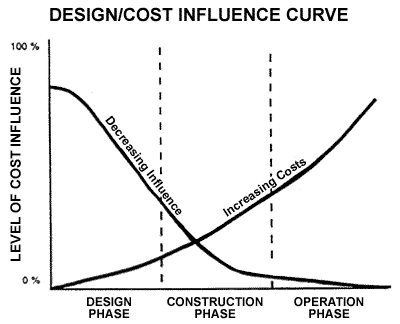
Instead, value engineering should occur during the design phase, not the bid stage when design decisions have the most flexibility and the maximum benefit (see cost-influence curve). And the objective shouldn't just be to lower cost, but to achieve the desired guest experience most economically. To do this, the design team should include not just architects and designers, but the contractors and subcontractors who know how to cut costs without diminishing the guests' experience. You also need someone who truly understands what the target guests want and what must be maintained to deliver the required experience.
Setting budget independent of needs
Often, investors/developers of a LBL set unrealistic financial expectations for the return. Why determine the investment based upon a 30% return when 25% is the most you can realistically expect? The result is too little investment, on the low side of the investment sweet spot curve. We have also seen this happen when developers say, "That's all I can afford" or "This is the maximum amount I have to invest regardless of what the projections show." So they try to fit 10 gallons of guest experience into an eight-gallon bucket, and end up with a project that continually struggles.
Unrealistic cost estimates
Unrealistic estimates can result from a number of factors. One of the most common is using square-foot and category estimates. Again, it's a matter of using averages when they don't match the requirements of real life. Local building costs and building code, zoning and regulatory requirements vary greatly from area to area. Big items that are easy to miss include storm water management, impact fees, extension on water mains and fire hydrants for fire protection, building classification impact on cost, soil conditions, etc. When the cost estimate is not thorough and accurate, last-minute revisions remove guest value and add guest sacrifice.
Our company has found that the only way to set budgets that hit the investment sweet spot is to take the LBL's design to the schematic level during the feasibility stage, designing the project and its specifications to match the market. This means having a general contractor prepare a realistic construction estimate and it means including the FF&E as well as soft costs. Every item needs to be identified and accurately costed. Does the seating need to include booths, the preferred seating for parents with young children? Does the seating need to be a 30-minute chair or a two-hour chair? What will shipping and installation cost? And what are the likely soft costs, such as for training, marketing collateral, pre-opening labor and expenses?
With an accurate cost estimate, the developer/investors are in a position to see what their return will be, decide whether to proceed, and have a realistic budget that will hit the investment sweet spot.
Using other LBLs as the benchmark
Often, LBL developers charge forward with their plans based upon what some other project cost. That project usually is in another area of the country, built one or more years earlier, and never serves the same market and the same demographic/socio-economic niche market. Why would a LBL built for a middle-class market in Alabama in 1998 cost the same as a LBL built for an upscale market in Colorado in 2002? The answer is, it won't.
Setting budget by adjusting investment to produce desired return
This is a variation on letting the desired rate of return determine the investment. Our company has witnessed this many times. What happens is the feasibility study is conducted, including a schematic plan and a detailed cost estimate. The client looks at it, says they need to reduce the cost for a higher return, so parts of the project are removed. The projections aren't then revised to reflect that they've reduced the LBL's critical mass and mix, substantially reducing its draw and per caps. They're surprised, but we aren't, when the LBL closes several years after it opens, or is sold for much less than its cost, because it cost much less than what was required for success.
Phasing the project
We have seen LBL developers fall in this trap numerous times. A market and economic feasibility study results in project recommendations. The developer looks at the cost and decides to do the project in two phases, thinking that once the project gets going, he can borrow the money for the second phase. Big mistake. The project was recommended based upon achieving a critical mass and mix assortment for the projected market penetration rates and per capita spending. When only a fraction of the project is developed, the formula is way off. The developer who thought he was reducing risk by building in phases almost always ends up with the worst outcome, a failed partial project.
You can go nuts - and broke - trying to sell Camry to a Hyundai or Mercedes market. While it isn't easy to hit the investment sweet spot, it's absolutely crucial. It requires making choices the right way, based on what will pull your target market into your LBL. Listen to your market and to industry experts on the size and scope of the project you need to attract your market, and you have a good chance for the success that follows giving people exactly what they want.
Randy White is the CEO of the White Hutchinson Leisure & Learning Group, a Kansas City, Missouri, USA firm that specializes in the production and design of family and children's leisure venues worldwide. Randy can be reached at voice: +1.816.931-1040, fax: 816-756-5058, by e-mail or on the web: www.whitehutchinson.com.