
Making Museums, Zoos, Aquariums, Botanical Gardens
& Other Cultural Institutions Family and Child Friendly

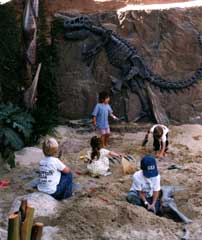
Dinosaur dig designed by White Hutchinson. Young children learn best and enjoy themselves with hands-on activities where their skills match the task at hand. |
Families are an important market for museums, zoos, aquariums, botanical gardens and other cultural institutions. By its very definition, family means children. Our studies have shown that at most facilities, a significant portion of the children visiting are 9 years old or younger. Children 9 years and younger make up 14% of the 2000 US population and even a greater percentage in other countries. In 2000 in the US, 33% of all households had children. The majority of those households had at least one younger child.
Although most facilities target the family market for a substantial portion of their business, their facilities often fail to be truly family and child friendly.
Designing a quality and culturally appropriate environment for families and their children is a highly complex, specialized and unique skill. The physical environment; including its atmospherics, layout, equipment exhibits and furnishings; and the management of the facility has a profound impact on families' and children's fun, learning and behavior. Children of different ages have unique needs and interests. Parents needs must also be addressed.
The design of the environment has a profound impact on the behavior of young children. Young children read the environment differently than adults. They look for ways to interact with it. Often, when adults think a child is misbehaving, the child is responding exactly the way the environment "told" them to and set them up to behave. Environments that do not take this into account, not only produce undesirable, and possibly unsafe, behaviors from children, but the behavior can also disturb the enjoyment by other patrons. If a family visits, and their children misbehave and are bored, the family doesn't have a pleasant experience, doesn't return, and doesn't recommend the facility to their friends.
Boredom is an important design issue when it comes to younger children visiting a cultural facility. Young children learn differently than adults and older children. They are bored by passive exhibits (except of course with swimming sharks). They have a biologically programmed need to interact with the environment-to learn by hands-on, interactive experiences. Interactive in this case does not mean pushing a button and having technology talk to you. It means manipulation of the environment.
Mihaly Csikszentmihalyi, a University of Chicago psychologist, has researched boredom in children. He says that boredom is caused by a mismatch between what children have the ability to do and what they are expected to do. They enjoy themselves, when their skills match the task at hand. If they're challenged beyond their capability, they become anxious and often claim boredom as a defense. If not challenged enough, they're bored. Since children's skill levels change constantly as they develop, the point where boredom sets in is a moving target.
Infant/Toddler areas have special design considerations. This area designed by White Hutchinson
is in a facility with a mission of teaching children about preservation of dugongs.
Linda Caldwell, a professor of leisure studies at the University of Pennsylvania, has identified another factor in boredom. She says children become bored when they don't think they have control over their lives and in what they are doing. This conclusion is supported by Csikszentmihalyi, who points out that when an individual's capabilities are balanced with the challenges of a particular activity, the result is a sensation of confidence, or being in control.
Children's development runs a predictable course. The best way to approach design for children is to have exhibits and events that meet their needs progressively as they develop-a continuum of challenge that allows their skills and interests to match the task at hand.
Anthropometrics are very important. Design needs to match the size, physical range and abilities of children-and this varies greatly as children grow. This requires activities and events that are designed to work for a wide range of ages. For example, the average height variation between a 3-year-old and an 8-year-old is 14", or almost 40%. All to often, cultural environments are only designed with adults in mind. They accordingly set younger children up to feel incompetent, to not be able to enjoy exhibits, often to not even be able to see exhibits. It is important to follow the principal of universal design, to make the environment usable by all patrons-adults, people with disabilities and children.

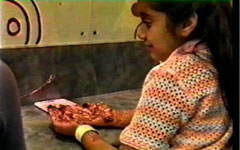
Children can experience the ancient and still practiced art of henna/mendhi at this do-it-yourself exhibit White Hutchinson developed for a facility in Arabia. |
The White Hutchinson Leisure & Learning Group understands the importance of having the design of the entire environment, including the building, equipment and its management, assist and support, rather than impede, children's fun and learning, parents' needs and enjoyment and staff's abilities to accomplish their jobs. We are an experienced child- and family oriented, multi-disciplinary group of professionals who work as a team to design and oversee the development of high quality and successful family and children's leisure and learning environments. Our staff includes an Education & Child Development Director with over 28 years experience with children's education and enrichment facilities.
With our focus and extensive experience in developing market strategies and designing leisure, edutainment, play, learning and enrichment facilities for families and children, the White Hutchinson Leisure & Learning Group has the specialized expertise to:
- understand the unique needs of families, and especially woman and younger children,
- understand how to set-up the logistics and facility to support enriching school field trip programs, including pre and post trip curriculum teacher support materials.
- assist museums, zoos, aquariums, botanical gardens and other cultural institutions with developing strategies and designing renovations and additional facilities to appeal to this important family market.
We understand how to design the physical environment, operations and all aspects of a business to not only meet the needs of families and children, but also how to delight families so all family members will have an enjoyable and enriching experience and become apostles for your institution.
For existing facilities who wish to evaluate their family friendliness, we also offer the service of "Family Friendly Audits." Our highly skilled staff will conduct an audit of your facility over several days and prepare a report with recommendations of how improve your facility's appeal to families.
We have extensive experience in designing children's learning, enrichment and play facilities and family leisure destinations. See other sections of our web site for information about our work with children's edutainment centers, educational facilities, discovery and adventure play gardens, and family leisure destinations.
Also see our article
The Importance of Cultural Competence to Informal Learning Attractions
(or as )
that was published in The Informal Learning Journal, and our article
Moving from Biophobia to Biophilia: Developmentally
Appropriate Environmental Education for Children.
Our
work with museums and cultural institutions includes:
Abraham Lincoln Presidential Museum
BRC Imagination Arts, the design producers for the new award wining Abraham Lincoln Presidential Museum in Springfield, Illinois, retained White Hutchinson as design consultants for Mrs. Lincoln’s Attic, the children’s play area in the museum.
Old Sturbridge Village, Sturbridge, MA
This popular living farm destination has retained White Hutchison to conduct
a family-friendly audit and assist them in developing strategies, exhibits
and programs to increase family appeal.
Botanical Garden & Children's Discovery Garden, Naples, Florida, USA
BRC Imagination Arts, the design producers for a new multi-million dollar botanical garden to be built in Naples, Florida retained White Hutchinson as design consultants to assist them with conceptual design work. White Hutchinson's scope of work included the children's discovery garden, development concepts for school field trips and other programming, design considerations to accommodate school field trips and design and programming considerations to make the gardens family friendly.
NASA Kennedy Space Center Visitor Complex, Florida
WHLLG was retained to conduct a family friendly audit
of this popular Florida tourist attraction. Our work included technical assistance
on the design of the physical environment and how it affects children and
families, child safety issues, appropriateness of exhibits and presentations
for families and children, use by visitors of other cultures and languages,
and recommendations for new facilities and activities to increase the facility's
appeal to families with children.
Colossal Cave Mountain Park, Vail, Arizona, USA
WHLLG was retained for strategic and master planning for expansion of this 5,000 acre park and tourist attraction with a nature- and historic-based interpretive museum and interactive learning center to educate children and their families about preservation of the Arizona ecosystem, including the history and practice of environmentally responsible ranching.
Lion Country Safari, West Palm Beach, Florida, USA
The country's oldest drive-through animal park features over 1200 wild animals roaming free in a natural wildlife preserve. A second area of the park is the walk-through Safari World that includes rides, a petting zoo, restaurants and gift shops. The owners of Lion Country retained WHLLG to conduct a feasibility study and prepare a concept plan for a $5 million renovation and expansion of Lion Country Safari, including design of a new nature-based children's play area.
Story Stores, Inc.
Assisting Story Stores with concept development, attendance and financial projections and design of their innovative RoadStoryUSA for-profit museum concept that combines learning, playing, shopping, and dining.
|