

Full service child care design and architecture
Designing a high quality, developmentally and culturally appropriate child care center is a highly complex task that requires specialized and unique knowledge and skills. The White Hutchinson Leisure & Learning Group has the specialized experience and expertise to produce high-quality child care facilities.
One of our company's guiding child care design principles is that architecture should not be at the center of the design process, but rather the center's program goals (not architectural program) and the needs of children, staff and parents should drive the process. The physical environment is only one of the many aspects of developing a child appropriate, quality learning environment.
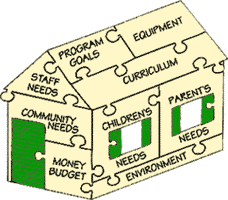
Designing a quality child care facility involves more than just architecture
Other important considerations include:
- Program Goals
- Curriculum
- Group Size
- Teacher Ratios
- Equipment & Furniture
- Staff Needs
- Parent Needs
- Cultural Sensitivity
Our Education & Child Development Director, Vicki Stoecklin, is the head of our design team to assure that the design process will meet these goals. Vicki has a Master's degree in Education and twenty-six years of experience in early childhood education. She has extensive experience as a child care director and a teacher. The past eight years of her career have been devoted to studying and practicing developmentally appropriate and high quality child care design. She has presented twenty-five training sessions on children's design issues at national and international conferences. Her articles on designing for children have been published in Early Childhood News and Child Care Information Exchange and by Head Start. Her article, "Designing for All Children," is used in the in the web-based, online accessibility training course for architects that was developed by The American Institute of Architects (AIA) in collaboration with the U.S. Architectural & Transportation Barriers Compliance Board (Access Board). Vicki, as head of our child care design team, has the background and experience to assist child care owners/directors, staff and parents in translating their needs into a quality design. With her experience as a child care director, she understands operational issues, which are an important design consideration.
In a traditional child care design process, the architects, who don't have specialized knowledge of child development and child care issues, are at the center of managing the design process. The child development expert, if there is one, is on the outside, occupying a limited role. More frequently, architects don't retain a child care design expert, but instead rely on input from center owners and directors who don't have expertise in child care design.
Our child care design team is not headed by an architect, but rather by Vicki, an early child care education expert, who oversees all aspects of the design process. The process starts with her initial meeting with center director/owner and staff to first clearly define the center's program goals and operational standards. She also conducts a detailed assessment of the center's curriculum and teaching approach. Her pre-design work also includes developing the equipment and furniture needs and specifications, as, in the typical child care design process, too often the classroom is designed independent of the equipment, leaving teachers the impossible job of fitting equipment into a poorly designed room. Vicki works with the center owner/director to specify all equipment and furniture before the actual floor plan is developed. Our approach to child care design is to let the program goals, curriculum and equipment drive the design process.
Another unique aspect of our child care design team is to pay special attention to the classroom acoustics. Children make noise. Research shows that high levels of background noise adversely affects learning, especially for children with hearing loss or fluid in their ears, which covers a large population of preschool age children. Children with speech impairments or learning disabilities are also significantly affected. Acoustic guidelines have been adopted by the Acoustical Society of America (ASA) for classroom background noise and reverberation, which takes into account children with hearing loss. The standard removes acoustical barriers to learning by providing equal access to education for children who have mild to moderate hearing loss, learning or attention deficits, suffer from frequent ear infections or who have limited English language skills. For teachers, the standard means reduced stress and voice strain. Our design team includes an acoustics engineer to assure that the environment will comply with these quality standards.
Lighting design is also an important design consideration - both the use of appropriate artificial light and natural light. Research has shown that the type and amount of light has an impact on children's behavior and learning, as well as on teachers' and staff well-being. To assure that classrooms meet quality lighting standards for children based upon the most recent research, our design team includes a specialized lighting consultant.
In terms of playground design, our philosophy is that the outdoor space is not just a playground, but rather an extension of the classroom. Design quality outdoor environments is more complex than just selecting manufactured equipment. We approach the design of the outdoors the same as the indoors - it needs to support all the learning domains for children's development. Each classroom should have direct access to age appropriate outdoor areas for children.
Our firm has extensive national experience in developing outdoor play and learning environments that use nature for a significant part of the play experience. Rather than call them playgrounds, we call them outdoor discovery play gardens. We have created outdoor environments in child care centers, child development centers, Head Start and Early Head Start programs across the country. The outdoor space needs to be designed concurrently with the design of the building to assure the best use of the site and that the outdoors will be an integral part of the classroom.
Our child care design team includes professionals in the following design disciplines:
- Child Development & Learning
- Child Care Center Operations & Management
- Child Care Center Equipment & Furniture
- Universal Design and Special Needs Children
- Architecture
- Interior Design
- Lighting
- Landscape Architecture
- Acoustics
- Civil Engineering
- Mechanical/Electrical/Plumbing
- Structural Engineering
To learn more about how our child care design team can assist you in renovating or developing a new facility, contact Vicki Stoecklin at +1.816.931-1040 or via e-mail.