
This is a print-friendly version of www.whitehutchinson.com/news/lenews/2017/february/article107.shtml


White Hutchinson Leisure & Learning Group

White Hutchinson Leisure & Learning Group, Kansas City, MO, USA


Vol. XVII, No. 2, February 2017


  1. Editor's Corner (www.whitehutchinson.com/ news/ lenews/ 2017/ february/ article101.shtml#article)
  2. Staying in is the new going out; welcome to Generation Homebody (www.whitehutchinson.com/ news/ lenews/ 2017/ february/ article102.shtml#article)
  3. Are staycations going kaput? (www.whitehutchinson.com/ news/ lenews/ 2017/ february/ article103.shtml#article)
  4. 3 seminar programs and 2 trade shows for the price of one (www.whitehutchinson.com/ news/ lenews/ 2017/ february/ article104.shtml#article)
  5. Digital now has a necessity status (www.whitehutchinson.com/ news/ lenews/ 2017/ february/ article105.shtml#article)
  6. The rise of bar-tainment (www.whitehutchinson.com/ news/ lenews/ 2017/ february/ article106.shtml#article)
  7. 3.4 million missing babies (www.whitehutchinson.com/ news/ lenews/ 2017/ february/ article107.shtml#article)
  8. Benchmarking mediocrity (www.whitehutchinson.com/ news/ lenews/ 2017/ february/ article108.shtml#article)
  9. Consumer trends in 2017: 36 expert perspectives (www.whitehutchinson.com/ news/ lenews/ 2017/ february/ article109.shtml#article)
  10. Is your website ADA compliant? (www.whitehutchinson.com/ news/ lenews/ 2017/ february/ article110.shtml#article)

[ Index of Previous eNewsletters (www.whitehutchinson.com/ news/ lenews/ previous.shtml) ]


3.4 million missing babies

The Great Recession sent an economic shock through American society that reached far beyond the stock and housing markets. More than five years after economists announced the end of the recession, fertility levels have still not recovered.

A study from the UNH Carsey School of Public Policy found that more than 3.4 million fewer babies were born in the United States between 2008 and 2015 than would have been expected if pre-recession fertility rates had continued. In each of the last five years, this birth deficit has resulted in roughly 500,000 fewer births.
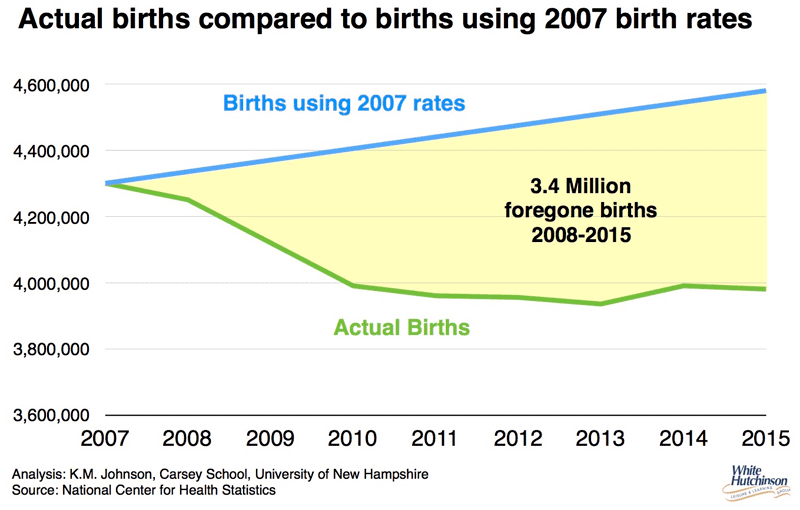
As result, there were 10% fewer children age 0-7 in the U.S. in 2015 than if the pre-recession birth rate had been maintained.

Nor does new data show any evidence of an upturn in births. The National Center for Health Statistics final data for 2015 shows the lowest general fertility rate on record with only 3,978,000 births. There were 338,000 (-8%) fewer births in 2015 than in 2007.
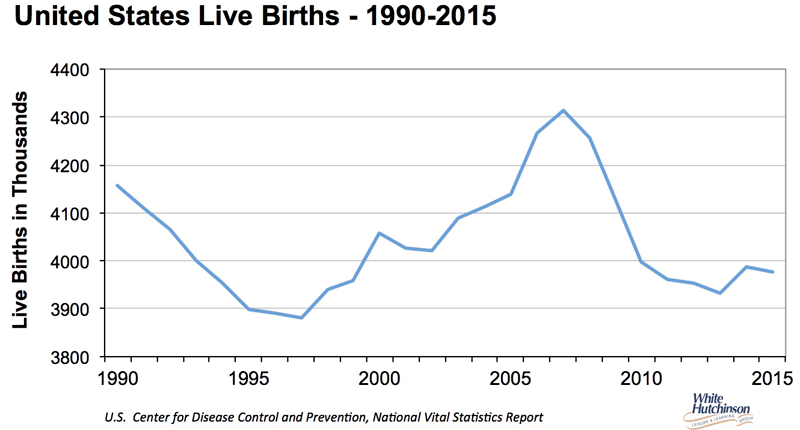
The decline in births is entirely due to reduced fertility rates. The number of women in their prime childbearing years (20 to 39) actually increased by 2.5 million (+6%) between 2007 and 2015. Yet the larger cohort of childbearing age women in 2015 had the lowest fertility rate on record. If the fertility rates of 2007 had been persisted through 2015, the larger cohort of women of childbearing age would have been expected to produce nearly 600,000 more children in 2015 than were actually born. In 2015, the larger group of childbearing age women gave birth to less babies than the smaller group in 2007.

The study said there is no evidence that births will rise soon despite an improving economy.

This obviously has implications for entertainment and edutainment centers that target children. Although the percentage of the population who are younger children is on the decrease, there is some good news. Check out our November 2016 article The shrinking children's market, the good news (www.whitehutchinson.com/ news/ lenews/ 2016/ november/ article103.shtml#article) .

Vol. XVII, No. 2, February 2017


  1. Editor's Corner (www.whitehutchinson.com/ news/ lenews/ 2017/ february/ article101.shtml#article)
  2. Staying in is the new going out; welcome to Generation Homebody (www.whitehutchinson.com/ news/ lenews/ 2017/ february/ article102.shtml#article)
  3. Are staycations going kaput? (www.whitehutchinson.com/ news/ lenews/ 2017/ february/ article103.shtml#article)
  4. 3 seminar programs and 2 trade shows for the price of one (www.whitehutchinson.com/ news/ lenews/ 2017/ february/ article104.shtml#article)
  5. Digital now has a necessity status (www.whitehutchinson.com/ news/ lenews/ 2017/ february/ article105.shtml#article)
  6. The rise of bar-tainment (www.whitehutchinson.com/ news/ lenews/ 2017/ february/ article106.shtml#article)
  7. 3.4 million missing babies (www.whitehutchinson.com/ news/ lenews/ 2017/ february/ article107.shtml#article)
  8. Benchmarking mediocrity (www.whitehutchinson.com/ news/ lenews/ 2017/ february/ article108.shtml#article)
  9. Consumer trends in 2017: 36 expert perspectives (www.whitehutchinson.com/ news/ lenews/ 2017/ february/ article109.shtml#article)
  10. Is your website ADA compliant? (www.whitehutchinson.com/ news/ lenews/ 2017/ february/ article110.shtml#article)

[ Index of Previous eNewsletters (www.whitehutchinson.com/ news/ lenews/ previous.shtml) ]


Mailing Address: White Hutchinson Leisure & Learning Group, 4036 Baltimore Avenue, Kansas City, Missouri 64111, USA
Telephone: +1.816.931-1040, Fax: +1.816.756-5058
E-mail: Please direct all messages for Leisure, Entertainment and Recreation Projects to Randy@whitehutchinson.com; and all messages for Children's Learning and Play Projects to Vicki@whitehutchinson.com.

© 1999 - 2026, White Hutchinson Leisure & Learning Group, Inc.
The contents of this website and eNewsletters are protected by USA and international copyright law. Permission is granted to download and print single copites of any of the contents or articles for personal use. No other copies may be made. Educational institutions may obtain permission to make multiple copies for classroom use by e-mailing us with details. The contents of articles may be quoted provided credit is given to the "(author's name), White Hutchinson Leisure & Learning Group, Kansas City, MO, USA". All other rights for use or reproduction of the contents and articles are reserved.