This is a print-friendly version of www.whitehutchinson.com/news/learnenews/2012/june/article104.shtml

[ Index of Previous eNewsletters (www.whitehutchinson.com/ news/ learnenews/ previous.shtml) ]
We have been training early childhood professionals for several years on how to choose healthy toys in our Institute on Creating Sustainable Environments. It is both exciting and shocking to see a major network cover the topic of unhealthy toys for our children. The following article was written by Julie Revelant for Healthy Mama and published May 23, 2012 on FoxNews.com
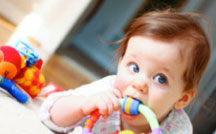
“You would never give your baby a lead pipe to chew on or some batteries to play with, but those teethers, rattles, play yards, toy trucks, and books that he plays with? They seem harmless, but the truth is that they could be filled with toxic chemicals, that with repeated exposure can have negative health effects and put your baby at risk for cancer, ADHD, learning disabilities, asthma, early puberty, infertility and autism.
In fact, unlike previous research that links autism predominately to genetic factors, a 2011 Stanford University School of Medicine study shows environmental factors to account for 62 percent of Autism risk.
Two hundred thousand toys were recalled between October 2010 and November 2011 because their lead content exceeded federal limits, according to a recent report published by U.S. PIRG. It wasn’t until August 2011 that toys with amounts of lead higher than 100ppm (parts per million) were banned; a limit the American Academy of Pediatrics says is still too high.
“Toys have long been a dumping ground for toxic chemicals,” according to Margie Kelly, an environmental health advocate and communications manager for Healthy Child Healthy World.
Yet lead is not the only chemical to be concerned about. Manufacturers use a host of chemicals in their products like phthalates, bisphenol A or BPA, and cadmium. Vinyl chloride, which is used to make polyvinyl chloride (PVC), a plastic found in toys and packaging is also commonly used. According to a recent report by the Center for Health, Environment and Justice, approximately 71 percent of toys tested at Toys “R” Us were presumed to be made of PVC.
What’s even more alarming is that even if the package states the toy is BPA-free, manufacturers can make “regrettable substitutions.” So by simply swapping out a chemical—BPA for BPS, for example, they’re able to claim the toy is BPA-free, and parents have no idea.
“It’s essentially the same structure but it doesn’t have the bad PR,” Kelly said.
Reform is Necessary
“Generations of children are growing up with the lack of protection from toxic chemicals,” according to Liz Hitchcock, legislative director for Safer Chemicals, Healthy Families, who points to the flawed 1976 Toxic Substances Control Act.
The U.S.’s main law, TSCA allows toys with dangerous chemicals to be sold without requiring manufacturers to disclose which chemicals have been used or have to demonstrate their safety.
“There’s a whole host of chemicals that children are exposed to for which there is no legal authority,” Hitchcock said.
The Consumer Product Safety Improvement Act of 2008 banned lead as well as toxic metals, yet only in the coating of toys. The act also permanently banned three types of phthalates, and three additional types on an interim basis but only in toys that can be placed in a baby’s mouth. The states have done their part as well, passing 31 laws to regulate chemicals in toys and toy jewelry.
In spite of these important milestones, environmental health advocates and parents say more needs to be done. In fact, on Tuesday, hundreds of moms, nurses, and cancer survivors rallied at the U.S. Capitol for the National Stroller Brigade in support of Senator Frank Lautenberg’s (D-NJ) Safe Chemicals Act.
If passed, the Safe Chemicals Act would allow the EPA to identify and restrict the worst chemicals, require manufacturers to disclose what chemicals they’re using and demonstrate that that they’re safe before they make their way into products and hit store shelves.
What You Can Do:
Despite the lack of consumer protection, there are steps you can take to ensure your child isn’t exposed. For starters, purchase fewer toys because less consumption means less risk. When you do buy toys, look for ones that are durable, made with unpainted or unvarnished wood, and choose organic cotton or wool, and cloth or plush types. Avoid plastics, even in books, and cheap metals often found in jewelry and cosmetics.
If you already own toys that you’re unsure about, use the database at healthystuff.org to check for chemicals. You can also check for recalls on the Consumer Product Safety Commission’s website and sign up for email alerts.
Email your state senators and urge them to pass the Safe Chemicals Acts of 2011.
“We have to get a handle on this problem and really regulate the chemicals that are coming into our children’s world,” Hitchcock said.”
Julie Revelant is a freelance writer specializing in parenting, health, and women's issues and a mom. Learn more about Julie at revelantwriting.com
Read more: http://www.foxnews.com/health/2012/05/23/shocking-truth-about-toys/#ixzz1yApS66sL
[ Index of Previous eNewsletters (www.whitehutchinson.com/ news/ learnenews/ previous.shtml) ]
© 1999 - 2026, White Hutchinson Leisure & Learning Group, Inc.
The contents of this website and eNewsletters are protected by USA and international copyright law. Permission is granted to download and print single copites of any of the contents or articles for personal use. No other copies may be made. Educational institutions may obtain permission to make multiple copies for classroom use by e-mailing us with details. The contents of articles may be quoted provided credit is given to the "(author's name), White Hutchinson Leisure & Learning Group, Kansas City, MO, USA". All other rights for use or reproduction of the contents and articles are reserved.