
This is a print-friendly version of www.whitehutchinson.com/news/learnenews/2005/01/article101.shtml

[ Index of Previous eNewsletters (www.whitehutchinson.com/ news/ learnenews/ previous.shtml) ]
Every day we find ourselves in many different places and spaces. Our environment affects the way we feel and behave, and the way we work. We all know that first impressions are powerful; therefore, the first message you want your child care environment to send to both children and families is that they are welcome and valued as part of your community. Children read the environment differently than adults, and when the environment speaks to the child, your role as a teacher changes dramatically. The cues and directions that children read come not from you, but from the way you have chosen and arranged the materials in your environment.
Here are nine specific strategies you can use to create positive and supportive messages in childcare environments you create for children. Positive environments give children the following messages: this is a good place to be, you belong here, this is a place you can trust, you can do many things on your own and this is a safe place.
The strategies are:
Arranging your environment so it will work for every child is a challenge.
Children with disabilities and special needs often do not learn from the
environment in the same ways that other young children do. They may wait
for adult direction or miss subtle cues. 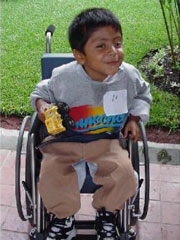 Children
with sensory integration problems, autism or attention deficit disorder
might be easily overwhelmed or distracted by too many visual elements
in the environment. Closed storage units or plain curtains over unused
items will help to simplify your room visually. Special furniture and
materials may be needed so that a child with a disability can fully participate
in all areas of the classroom. These may include adaptive chairs placed
next to a battery operated toy, a chair with special sides that enables
a child to sit in the group circle or a small carpet used to help define
a child's work and personal space.
Children
with sensory integration problems, autism or attention deficit disorder
might be easily overwhelmed or distracted by too many visual elements
in the environment. Closed storage units or plain curtains over unused
items will help to simplify your room visually. Special furniture and
materials may be needed so that a child with a disability can fully participate
in all areas of the classroom. These may include adaptive chairs placed
next to a battery operated toy, a chair with special sides that enables
a child to sit in the group circle or a small carpet used to help define
a child's work and personal space.
Every child in the program needs to be able to move freely throughout both the indoor and outdoor environment. Any barriers that make it difficult for a child to actively use play materials should be removed. If a child uses a wheelchair or a walker, more room will be required in each play area and props will need to be arranged so that they are within the reach of a young child using a wheelchair.
Props that are chosen for play areas should have a challenge for children of all developmental abilities. A four-year-old with a significant disability, for example, should not be expected to play with a baby's rattle simply because her developmental skills are limited. There are many props that interest-four year-olds, which can also be held, shook and mouthed, such as real keys or measuring spoons. In group settings, this is especially important because young children form opinions about their peers based on what they do and what they play with. By giving infant toys to an older child, you may be unwittingly signaling to other children that this child is a "baby" and not one of their peers. Likewise, if children with disabilities are unable to be toilet trained and must be diapered, the diapering area for older children should be private so that the children again don't get the wrong message. Toilet training and diapering can be emotional issues for young children.
While on the subject of diapering areas, what types of smells do you have greeting your parents and children? I still remember the smell of dirty diapers from an infant program I visited two years ago that kept the diapers in a LARGE Rubbermaid trash can to be emptied only at the end of the day. What kinds of messages does the smell of your center send to children and families?
As a final thought, toys, play materials, props and equipment must be arranged in a way that explicitly tells the child what can be done with the materials. Having the room "too picked up" does not give the child specific clues on how to use the materials, but rather, says "do not touch." When materials are displayed in unusual ways, children are more likely to notice and use them. Colorful strips of ribbon and fabric, tied to a wooden lattice, can be used with other common materials to create weaving walls. Bubble wrap taped to the pavement makes intriguing "popping sounds" as the children drive over it. Think of the environment as a textbook for a course. Fill it with rich materials so children will explore and play while learning content and developing skills.
How you arrange your environment is a simple and powerful teaching strategy.
For young children with disabilities, in particular, these approaches
can help them learn to respond to the cues in their environment, increase
chances for success, build self-esteem and teach lifelong skills in a
way that no other strategy can begin to match.
[ Index of Previous eNewsletters (www.whitehutchinson.com/ news/ learnenews/ previous.shtml) ]
© 1999 - 2026, White Hutchinson Leisure & Learning Group, Inc.
The contents of this website and eNewsletters are protected by USA and international copyright law. Permission is granted to download and print single copites of any of the contents or articles for personal use. No other copies may be made. Educational institutions may obtain permission to make multiple copies for classroom use by e-mailing us with details. The contents of articles may be quoted provided credit is given to the "(author's name), White Hutchinson Leisure & Learning Group, Kansas City, MO, USA". All other rights for use or reproduction of the contents and articles are reserved.