
This is a print-friendly version of www.whitehutchinson.com/news/learnenews/2004/06/article102.shtml

[ Index of Previous eNewsletters (www.whitehutchinson.com/ news/ learnenews/ previous.shtml) ]
Poison ivy rash is an unfortunate byproduct of being outdoors. Maybe you have children who have come to the center with poison ivy or maybe they have picked it up from being on your outdoor play yard. This article will help you understand how poison ivy works.
The rash we get from our exposure to poison ivy (as well as poison oak and
sumac) is an allergic reaction to contact with an oil called urushiol (oo-ROO-she-ol).
All species of poison ivy, oak and sumac have urushiol in their roots, stems,
leaves and fruit. The oil 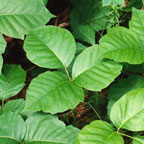 or
sap is released when plants are bruised. For this reason, poison ivy rashes
are more common in the spring and early summer when leaves and stems are tender.
The sap may be deposited on the skin by direct contact with the plant, through
contact with contaminated objects such as shoes, clothing, tools and animals,
or as airborne urushiol particles from burning plants.
or
sap is released when plants are bruised. For this reason, poison ivy rashes
are more common in the spring and early summer when leaves and stems are tender.
The sap may be deposited on the skin by direct contact with the plant, through
contact with contaminated objects such as shoes, clothing, tools and animals,
or as airborne urushiol particles from burning plants.
We're betting that you still cling to at least one of the poison ivy myths below. Now is a good time to set the record straight:
Not true. Fluid discharged from blisters will not spread the rash. Well before the blisters form, however, you may spread the urushiol on your hands to other parts of your body.
Not true. The rash is simply a reaction to urushiol. The rash cannot pass from person to person; only the urushiol can be spread by direct contact.
Not true. Direct contact or contact with smoke from burning plants is needed to introduce urushiol onto the victim.
Not true. A person's sensitivity changes over time, even from season to season. People who were sensitive to urushiol as children may not be allergic as adults.
Not true. Urushiol remains active on any surface, including dead plants, for up to 5 years!
Partly true. Urushiol can stick to your clothes, which you can touch and spread to your skin later.
[ Index of Previous eNewsletters (www.whitehutchinson.com/ news/ learnenews/ previous.shtml) ]
© 1999 - 2026, White Hutchinson Leisure & Learning Group, Inc.
The contents of this website and eNewsletters are protected by USA and international copyright law. Permission is granted to download and print single copites of any of the contents or articles for personal use. No other copies may be made. Educational institutions may obtain permission to make multiple copies for classroom use by e-mailing us with details. The contents of articles may be quoted provided credit is given to the "(author's name), White Hutchinson Leisure & Learning Group, Kansas City, MO, USA". All other rights for use or reproduction of the contents and articles are reserved.