


Vol. VII, No. 4, July-August 2007
- Editor's corner
- Kids dining out is not child's play
- Update on Three Rivers Park Children's Play & Discovery Center
- Discretionary income
- Beyond entertainment: A closer look at America's mindset of leisure experiences
- New minimum wage
- Service with a smile
- enewsletter recommendation
- Splurging in America
- Clean tables make all the difference
Discretionary income
So who has the most discretionary income in the U.S.? The answer might surprise you. This information is crucial for those in the location-based entertainment (LBE) industry, because if the demographic market you're currently targeting has empty pockets, you're sunk.
Discretionary income is the money that remains to spend or save after paying for the necessary costs of living, such as basic food, apparel, transportation, health care, housing and household operations, education and personal care. Categories of discretionary income include meals at restaurants (many meals at fast-food restaurants and employer and school cafeterias are categorized as necessary expenses) and all forms of entertainment, which includes visits to location-based entertainment facilities.
So who has the most discretionary income? We will look at the amounts, figured by both household income and type of household, based upon an analysis by New Strategist of the 2005 Consumer Expenditure Survey by the U.S. Bureau of Labor Statistics.
The average U.S. household had $11,253 in discretionary income in 2005. There is a correlation between household income and discretionary income. On average, households with less than $30,000 in annual income have no discretionary income. However, many still find a few dollars for a movie, video rental, dinner out or a six-pack of beer. That is because lower income households often spend more than they make, or find extra money from family assistance, borrowing or unreported income. In households with incomes above $30,000, discretionary income rises as incomes rise.
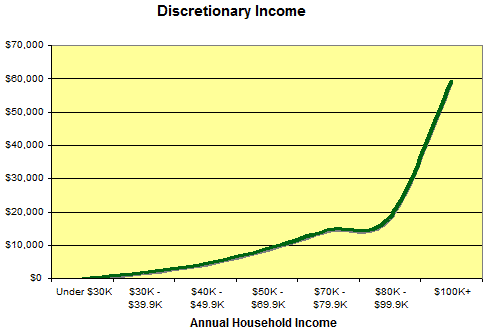
Households with $70,000 and higher annual incomes control 83% of all discretionary income. Households with $100,000 and higher incomes control 62% of all discretionary income.
Discretionary income is much higher for married couples, regardless of whether they have children at home, than for single-person households or for single parents with children at home. Single parents, on average, had no discretionary income in 2005, due to their low incomes. Single-person households had discretionary income of $4,271.
For married couples, discretionary incomes break down as follows:
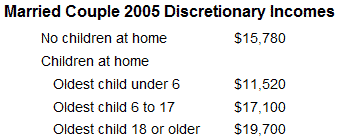
Married couples with children at home accounted for 37.5% of all discretionary income in 2005.
Households with lesser discretionary income are first to be impacted by economic conditions, including recessions, inflation and high gas prices. See the article below, Splurging, for more information on what consumers cut back on when times get tough.
Vol. VII, No. 4, July-August 2007
- Editor's corner
- Kids dining out is not child's play
- Update on Three Rivers Park Children's Play & Discovery Center
- Discretionary income
- Beyond entertainment: A closer look at America's mindset of leisure experiences
- New minimum wage
- Service with a smile
- enewsletter recommendation
- Splurging in America
- Clean tables make all the difference